In Williams v. Rent 2 Own Trailers, LLC, the Fifth Circuit held that the defendants in a lease dispute waived any protection by a provision requiring that any controversy “shall be settled first by good faith mediation” within 30 days after notice of the dispute.

The Court credited the complaint’s allegation that the plaintiff gave notice on June 15, 2023, and emphasized that the defendants neither sought mediation during the ensuing 30 days nor pursued it afterward. Instead, they waited until after suit was filed and invoked the clause as a barrier to litigation rather than as a genuine settlement mechanism. The Court also noted the defendants’ later litigation conduct, including their failure to request mediation after acknowledging in a case management plan that court or magistrate mediation could be an effective dispute-resolution technique. No. 25-20352, Jun. 18, 2026.

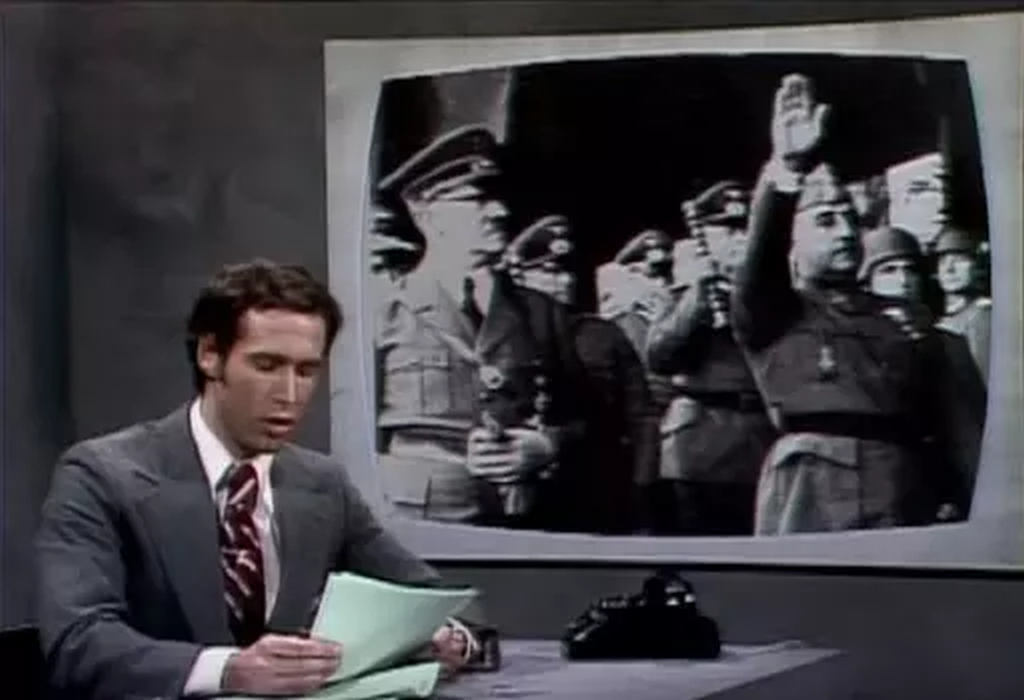
A running gag on Saturday Night Live in the 1970s featured Chevy Chase, hosting the “Weekend Update,” proclaiming: “Generalissimo Francisco Franco is still dead.

In that spirit, today the Supreme Court proclaimed that the Rooker/Feldman doctrine remains unchanged after today’s release of opinions, proclaiming: “The Court today neither expands nor constrains Rooker/Feldman.” T.N. v. Univ. of Maryland Health System, No. 25-197 (June 18, 2026).

In Wightman v. Ameritas Life Insurance Corp., the Fifth Circuit reversed and remanded fr a second time in a dental-network reimbursement dispute, holding that the district court – on remand from a prior Fifth Circuit reversal – had improperly refused to consider certain theories by concluding that those theories had been forfeited in the earlier appeal.

The Court court explained: “this court, not the district court, has the authority to determine whether to consider issues that may have been forfeited on appeal,” and that the district court’s refusal “violated the mandate rule, which requires a district court on remand to effect our mandate and to do nothing else.” No. 24-30775 (June 12, 2026).

In Providence Title Co. v. Truly Title, Inc., the Fifth Circuit affirmed summary judgment between two Texas insurance competitors, where one company’s new hires from their rival title company brought their clients and colleagues with them, resulting in alleged breaches of their fiduciary duties.

The case arose from a failed merger. After negotiations between Providence and Truly stalled, several Providence executives — including its president — negotiated their way to Truly, coordinated strategic office openings with data gained during merger dealings, and had a former Providence employee organized a “happy hour” that doubled as a group interview with Truly recruiters.

Providence sued Truly for knowingly participating in its executives’ breach of fiduciary duty. The Fifth Circuit affirmed dismissal of all of them. The Court followed the Texas intermediate-court opinion in Crossroads Hospice v. FC Compassus, which held that hiring at-will employees who secretly agreed to compete with their employer, and knowing about their disloyalty, does not constitute knowing participation. In each instance, Providence’s evidence tracked Crossroads closely: the executives acted largely on their own initiative, Truly required new hires to certify they wouldn’t use Providence’s data, and the happy hour took place the evening of the managing employee’s resignation, after her fiduciary duties had ended. No. 25-40194 (May 15, 2026)

In Students Engaged in Advancing Texas v. Paxton, the Fifth Circuit stayed a district court’s preliminary injunction against the Texas App Store Accountability Act, holding that the State made a strong showing that the law regulates, at most, commercial speech subject to intermediate scrutiny rather than the strict scrutiny the district court applied.

The Court found that app store listings “propose commercial transactions” because users browse a catalog of apps and download or buy them, and even apps that are “free” extract value through “access to user data and private information”. Because this is commercial speech, the State need only show a “reasonable fit” between the law and its goals, not the least restrictive means. The Court also noted the law “may not regulate speech at all, given that it does not target any substantive content but instead regulates commercial conduct with an incidental relationship to speech” No. 25-51073, Jun. 4, 2026.

In EnvTech, Inc. v. DeBusk, the Fifth Circuit reversed dismissal of a civil RICO claim built on trade secret theft as the predicate act.

The plaintiff alleged that the defendant, a CEO, directed a pattern of hiring competitors’ key employees and stealing their proprietary knowledge. The Fifth Circuit held that the plaintiff plausibly alleged both the predicate offenses and the pattern requirement—relatedness and open-ended continuity—by showing a consistent modus operandi: the defendant personally hired competitors’ employees and directed them to use stolen trade secrets for his company’s gain, triggering multiple lawsuits from 2020 onward.

On continuity, the court found the alleged scheme posed a threat of future repetition. The defendant had declined to discipline employees whose theft led to litigation, continued to push the use of stolen methods even after a lawsuit was filed, and testified that he “never thought about trade secrets” despite running a company that deals in proprietary cleaning technologies—a statement the court treated as a possible false exculpatory that made the modus operandi allegations more plausible. No. 25-40237 (Jun. 9, 2026).

In Blue Compass RV, L.L.C. v. Twin City Fire Insurance Co., the Fifth Circuit affirmed the dismissal of a $1.25 million crime-insurance suit,

After receiving a phishing email purporting to be from its construction contractor, an RV dealer updated the contractor’s payment information and remitted a progress payment to the fraudster’s account. The dealer’s insurance arrier paid the smaller sub-limit  for deception fraud involving the “purchase of goods or services,” rather than a larger limit. The dispute turned on whether the contractor’s construction work was a sale of “services” within that sub-limit.

The court rejected the insured’s argument that “services” should be read narrowly to mean only “useful labor that does not produce a tangible commodity.” Although some dictionary definitions support that reading, the Court concluded that in the context of the policy as a whole, a broader ordinary meaning controlled. Under that meaning, the contractor’s construction work qualified as services even though its end product was a tangible building. No. 25-10894 (June 5, 2026).

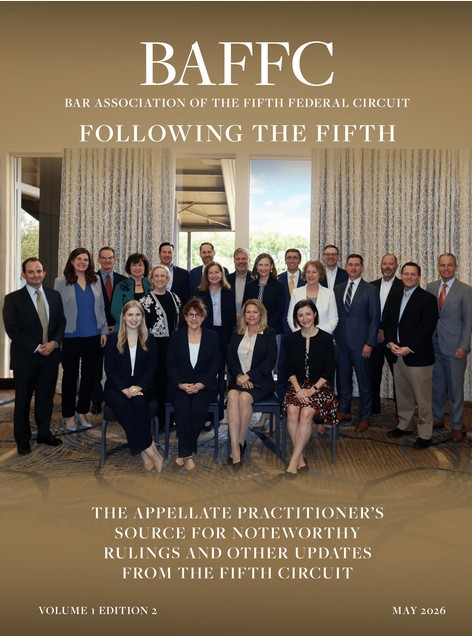
Somewhat belatedly, I’m proud to announce that the Bar Association of the Fifth Federal Circuit has released Volume I Issue 2 of “Following the Fifth,” its new flagship publication the work of the Fifth Circuit. Join BAFFC and have this – and many other resources – delivered straight to your inbox!

The baffling interplay between the administrative state and the Seventh Amendment gained another wrinkle today in FCC v. AT&T, which reversed a Fifth Circuit judgment and explained:

Even if the Commission’s orders do not require payment, [the telecommunication carriers] contend, the Seventh Amendment nonetheless applies because forfeiture orders have legal effect—namely, they enable the Department of Justice to initiate a § 504 suit. But the Seventh Amendment “secure[s] a right to the individual,” that attaches when “legal rights” are to be “determined,” A forfeiture order under 47 U.S.C. § 503(b)(4) does not determine legal rights; it is simply a “prerequisite[ ] to suit” that must be met before the Department may bring a collection action. It is thus analogous to a right-to-sue letter, or an exhaustion requirement–statutory conditions precedent that enable a subsequent suit. The Seventh Amendment does not extend to such “preliminary” procedures.

Nos. 25–406 and 25–567 (June 4, 2026) (citations omitted).

The plaintiff in Gemstone Foods, L.L.C. v. JPMorgan Chase Bank, N.A, was a Mississippi food processor with no banking relationship with Chase. Nevertheless, it alleged that Chase failed to adequately vet certain account-holder and thus facilitate the misdirection of $187,000 in wire transfers into sham accounts. The Fifth Circuit held that Chase owed no duty of care to a non-customer under Mississippi law. The court was not persuaded that the “sham account” issue created enough of a factual difference from earlier precedent to allow departure from it under the rule of orderliness, or to require certification to the Mississippi Supreme Court. No. 26-60049 (May 29, 2026).