In Megatel Homes v. City of Mansfield, a developer needed water from a special utility district, that held the exclusive state-issued “certificate of convenience and necessity.” The district, however, had contractually agreed to not provide water within the city’s extraterritorial jurisdiction without the city’s prior written consent.

The developer sued under the Sherman Act. The city claimed state-action immunity. The Fifth Circuit agreed that the Texas Water Code expresses a clear state policy to displace competition with monopoly in the provision of water services, but held that the city was not the intended beneficiary of that policy. In other words, the Water Code’s authorization of monopolistic behavior runs to the holder of a certificate, which is the utility district and not the city. No. 25-11006 (5th Cir. Mar. 26, 2026)
In Archer Western Contractors LLC v. McDonnel Group, LLC, the Fifth Circuit applied its precedent in Moss v. Princip to hold that a partnership—and by extension a joint venture—is not necessarily indispensable when each of its partners is a party and “relief can be tailored to reduce prejudice to the absent partnership.” The court also noted that a Rule 17(a) real-party-in-interest argument does not bear on the Rule 19 joinder analysis, because “the fact that an absent person could bring the action as a real party in interest does not of itself make that person a necessary or indispensable party.” No. 25-30321 (Mar. 26, 2026).

In Arnesen v. Lutnick, the Fifth Circuit addressed whether members of the Gulf of Mexico Fishery Management Council are officers of the United States, who must be appointed pursuant to the Appointments Clause.

Applying the “significant authority” test from Lucia v. SEC, the Court held that only one power — the Council’s ability to veto certain actions by the Secretary of Commerce, including the repeal of fishery management plans — conferred significant authority on Council members. The Council’s other powers (authority to propose plans and amendments, to assemble the supporting record, and to request emergency regulations) did not rise to that level, because the Secretary kept ultimate review and control over them.

From there, the Court severed those provisions, and concluded that the Council’s residual powers made its members mere “advisors or employees and not subject to the Appointments Clause”. Severance was appropriate because (1) the statute can function independently without the veto power, and (2) Congress’s core purpose of informed, cooperative fishery management remains in place. And because the unconstitutional veto provisions were not exercised in developing the fishery-management amendment at issue, the Court held that the implementing regulation “need not be vacated either.” No. 24-60055 (Mar. 27, 2026).

After the panel majority’s decision in Ford v. McKesson, a long-running case is headed for trial. Officer John Ford sued DeRay Mckesson, alleging that he was injured during a protest led by McKesson.

The majority held that summary judgment was improper because a jury could reasonably find for Ford on each part of his Louisiana negligence claim. In the court’s view, the record contains enough evidence for a jury to decide whether Mckesson helped organize and lead the Baton Rouge protest, whether he did so in a way that foreseeably created a violent confrontation with police, and whether that conduct was a but-for cause of Ford’s injuries. The court also rejected the argument that the First Amendment bars the case from reaching trial.

A dissented argued that the plaintiff’s proof, whatever may have been enough at the pleading stage, is too thin at summary judgment. In her view, the majority stacks inference upon inference about Mckesson’s role, causation, and the identity of the rock-thrower. She also warned that allowing the case to proceed risks chilling protest activity by turning disorderly reactions of others (a “heckler’s veto”) into a basis for speaker liability. No. 24-30494 (March 19, 2026).

Based on the Supreme Court’s recent Jarkesy opinion about jury-trial rights and administrative tribunals, the Fifth Circuit required a deceptive-advertising claim to proceed before a jury in Intuit v. FTC:

Caselaw from soon after the passage of the FTC Act reflects a widespread understanding that the statute encompassed common law actions for “deceit,” “fraud,” and “unfair use.” Deceptive advertising claims enforceable by the FTC arose from these traditional concepts. As former FTC Chair Timothy Muris put it, the Commission “help[s] to reinforce the common law rules of exchange” when it acts under its authority to “stop unfair or deceptive acts or practices.” Precedent, particularly the Jarkesy decision, confirms that FTC’s adjudication of deceptive advertising claims does not involve public rights, and the agency must therefore redress deceptive advertising in Article III courts. 

No. 24-60040-CV, March 20, 2026 (citation omitted) (Editor’s Note: as for the above picture of a 1790s-era jury, I tried, but ChatGPT can only conjure up so much diversity when it comes to hats and Colonial neckwear.)

A gracious man with a powerful commitment to the rule of law, Hon. Grady Jolly passed away on March 16. As summarized well by Senator Wicker from Mississippi:

“Circuit Judge Grady Jolly was an outstanding and respected jurist — a credit to the federal bench and to his native state. He had a quick wit and an even quicker mind. He was dedicated to the Constitution and the rule of law. I have been privileged to know him and benefit from his counsel. Mississippi has lost a giant.”


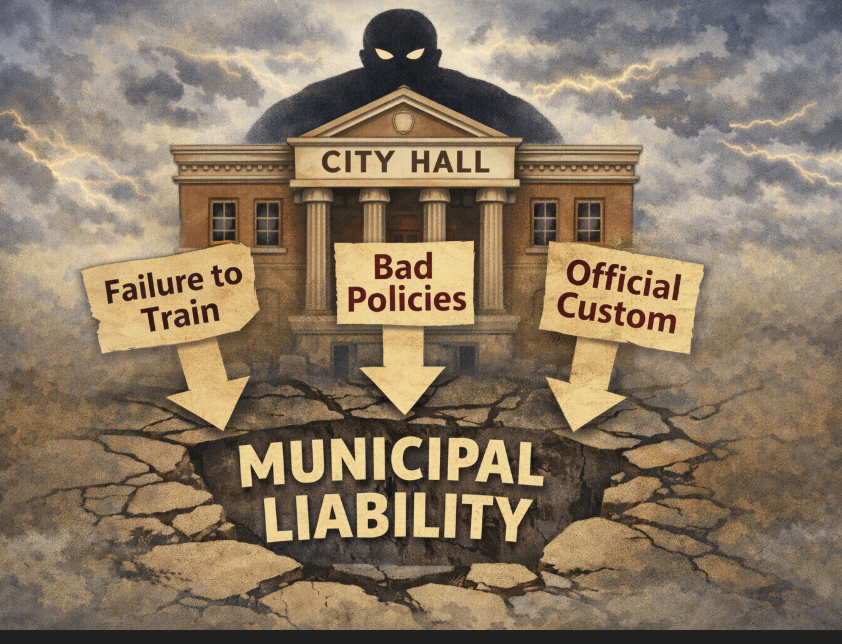
In Cambric v. City of Corpus Christi, the Fifth Circuit affirmed the dismissal of a § 1983 claim against a municipality for failure to adequately plead municipal liability under Monell. The plaintiff alleged that the city engaged in selective enforcement of its building code in violation of the Equal Protection Clause and sought to hold the city liable based on a “pattern, practice, and custom” of selective enforcement.

The Court held that the plaintiff’s allegations were insufficient to establish an actionable custom for municipal liability purposes. Although the plaintiff cited one instance of allegedly unequal treatment—the city’s support for a different historical restoration project—the court found this comparison inadequate to demonstrate a pattern of constitutional violations.

A concurrence clarified that the court’s recent decision in Hershey v. City of Bossier City, which allowed a single-incident Monell claim to survive dismissal on a failure-to-train theory, should not extend to claims alleging that policymakers selectively enforced a statute or ordinance. No. 25-40126, Mar. 13, 2026

In In re Alliance Liftboats, LLC, the Fifth Circuit denied a petition for a writ of mandamus seeking review of a district court’s collective-action certification order in a Fair Labor Standards Act case. The petitioner argued that mandamus was its only available path to relief, because collective action is otherwise non-appealable, and that improper certification would cause irreparable harm.

As to the substantive ruling, the Court held that an employer can preserve its challenge and raise the issue on ordinary appeal from final judgment. As for the claimed harm from litigating as a collective action, the Court said that to obtain mandamus relief, “[t]here has to be a greater burden, some obstacle to relief beyond litigation costs that renders obtaining relief not just expensive but effectively unobtainable.” No. 26-30091, Mar. 11, 2026; cf. In re JP Morgan Chase, 916 F.3d 494 (5th Cir. 2019) (denying mandamus relief but staying the district court’s order about individual notice for thirty days to allow reconsideration).

Savage v. La Salle Mgmnt. Co. illustrates when a “series of unfortunate events” warranted dismissal of a case for not making reasonable efforts to move the litigation along. While one should not feel comfortable missing fewer deadlines than occurred here, one should feel very uncomfortable about missing more:

  1. October 2022 – Initial Discovery Requests: Plainitff’s counsel in an employment case failed to respond to Defendants’ interrogatories and requests for production for approximately five months.
  2. March 2023 – Motion to Compel: Counsel did not oppose Defendants’ motion to compel because he was “unaware” of it.
  3. Order Granting Motion to Compel: Counsel failed to comply with the magistrate judge’s order directing discovery responses and payment of $300 in attorney’s fees.
  4. Denial of First Motion to Dismiss: Despite the district court vacating the schedule, delaying trial, and assessing an additional $600 in fees, Counsel still did not prioritize the case.
  5. Eight-Week Discovery Extension: Even after the magistrate judge granted additional time to complete discovery, no case development occurred.
  6. Third Continuance with Explicit Warning: Counsel failed to produce discovery or schedule depositions despite the court’s warning that it would not continue trial again.
  7. April 2024 Discovery Conference: Depositions discussed at the conference never happened.
  8. Second Motion to Exclude: As the fourth trial date approached, discovery still had not progressed after four years of litigation.
  9. Status Conference: Counsel “forgot” to attend the status conference on Defendants’ motion to exclude, despite evidence that he received the ordinary notice of it.

No. 25-30259 (March 9, 2026).

In Wilson v. Centene Mgmnt. LLC, the Fifth Circuit vacated an order denying class certification, concluding that plaintiffs had established Article III standing at the class-certification stage.

Specifically, the Court held that the named plaintiffs adequately established individual standing through allegations and evidence of injury-in-fact, causation, and redressability: they alleged overcharges for a health insurance policy with materially inaccurate provider directories, the overcharges were fairly traceable to the discrepancy between the promised and actual network, and they would be refunded if successful.

The Court further held that plaintiffs need not prove the precise dollar amount of damages at this stage, stating, “Although the Plaintiffs will ultimately have to prove whether and to what extent they were overcharged based on the inadequacy of the network, they do not need to prove how to measure that injury in dollars at the class-certification stage.”

This opinion differs from the Court’s now-withdrawn, July 2025 opinion, which had formally  adopted the “class-certification approach” to determining standing and held that once individual standing is established, the remaining analysis should occur under Rule 23. This revised opinion expressly declined to resolve a circuit split on this point, analyzing the plaintiffs’ claims under both recognized approaches, and concluding that no choice was necessary because plaintiffs had satisfied both. No. 24-50044, Feb. 19, 2026