This week, the Fifth Circuit’s website reports the following about Judge Dennis taking inactive senior status:

As of February 23, 2026, Judge James L. Dennis has taken inactive senior status. After serving in the United States Army, Judge Dennis graduated from Louisiana Tech University and Louisiana State University Law School. After graduating law school, he worked in private practice and served as a state representative in the Louisiana House of Representatives. He then became a state judge in Louisiana, serving on the Louisiana District Court, Fourth Judicial District; the Louisiana Court of Appeal, Second Judicial Circuit; and the Supreme Court of Louisiana. He has served honorably on this court for just over thirty years. We thank him for his long and distinguished service to this court and our country.

Two recent opinions – one from the Fifth Circuit, one from the Southern District of Texas – have addressed constituaional challenges to state education laws, and turned on issues of procedure.

In Roake v. Brumley, the Fifth Circuit, sitting en banc, vacated a preliminary injunction against Louisiana House Bill 71, which requires public schools to display the Ten Commandments in every classroom. The court did not rule on whether the law is constitutional; instead, it held that the challenge was not ripe for judicial decision because the statute confers discretion on local school boards regarding the nature of the displays, and the full context of how the law will be implemented remains unknown. Dissenting opinions would have addressed the merits.

And in GSA Network v. Morath – a district court opinion on an issue that is likely to reach the Fifth Circuit at some point – the court enjoined the Houston, Katy, and Plano Independent School Districts, barring them from enforcing several provisions of Senate Bill 12, a law regulating clubs, curriculum, and policies related to sexual orientation and gender identity in public schools. The court found that the three school districts, though actively implementing SB 12, explicitly declined to defend the law on the merits, filing only brief responses that took “no position” on its constitutionality, creating a waiver under party-presentation principles. And although the Commissioner of the Texas Education Agency did offer a defense, the court dismissed him from the case for lack of standing, finding that the plaintiffs’ injuries were traceable to the school districts themselves—not the Commissioner—because SB 12 vests implementation and enforcement authority in local school boards.

There have been two recent opinions about generative AI that you should know about

  1. The Southern District of New York recently held that a client’s queries of ChatGPT about a lawsuit WERE NOT PRIVILEGED. My law partner Chris Schwegmann has an excellent analysis of that ruling and its practical implications in this recent Texas Lawbook article. I highly recommend it, Chris is way ahead of the curve in thinking about “what next?” after this important ruling.
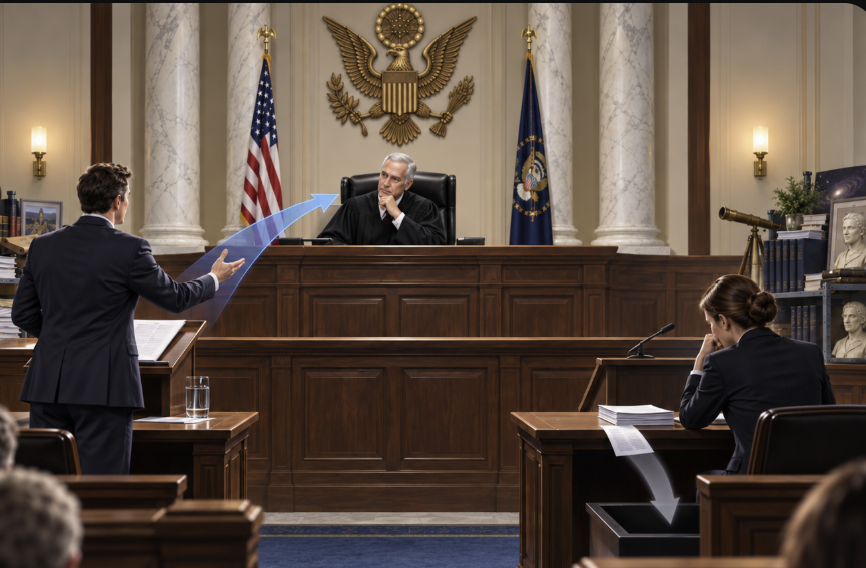
  2. The Fifth Circuit has had it with the scourge of hallucinated citations (iillustrated, fittingly, by generative AI to the right), and recently sanctioned a lawyer $2,500 for filing a brief with 21 shady citations (and evasive followup when asked about them). The case is Fletcher v. Experian and here is my recent Texas Lawbook article about it, and some practical lessons that it teaches (namely: (a) “don’t eat soup with a fork,” using general-purpose AI products for the wrong purposes; (b) don’t ignore “red flags” about citations and quotes that are too good to be true; and (c) if you make a mistake, for goodness sakes just apologize and move on, rather than trying to stall an obviously upset judge or judges.)

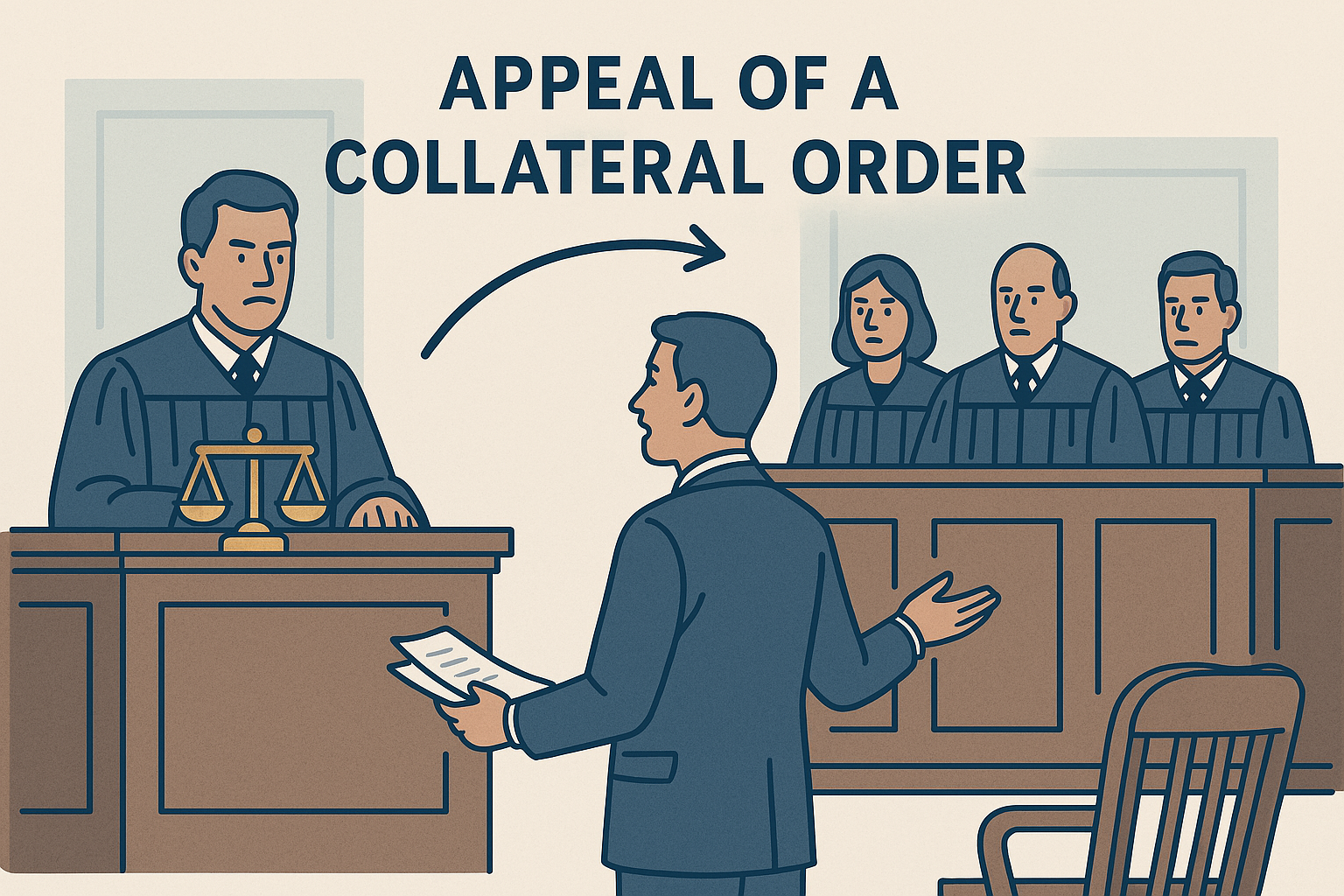
My friend Art Ayala recently visited the Texas Appellate Law Podcast to discuss the complexities of securing supersedeas bonds when a client faces an adverse verdict. Key topics include:

Timing: Why counsel should consider advising clients to initiate the bonding conversation even before a judgment is entered.
Process: How process typically flows from the initial call with a client to bond issuance.
Collateral Options: Pros and cons of various collateral options.

You can listen to the full conversation here: Supersedeas Bonds in the Real World.

In Associated Prof. Educators of La. v. EDU20/20, LLC, the Fifth Circuit addressed a classic “bad leaver” case about a former employee who had worked for his employer and a competitor at the same time.

On the employer’s Lanham Act claim, the court reversed summary judgment in favor of the defendants, holding that declarations from two attendees who assumed an affiliation between competing educational organizations, based on the defendant’s use of the plaintiff’s logo in presentations, constituted competent evidence of actual confusion. The Court emphasized that at the summary judgment stage, inferences must be drawn in favor of the nonmovant, and “misdirected inbound inquiries,” such as emails sent to the wrong organization, “are ‘indicia of actual confusion.'”

On the trade secret claims, the court affirmed summary judgment for the defendants. The Court held that the plaintiff’s mentor-training materials did not qualify as trade secrets because they were shared with training participants who had no confidentiality obligations. As to a client list that the plaintiff alleged was misappropriated, the Court held that the plaintiff failed to demonstrate with competent summary judgment evidence that the list even existed. And as for a member database, the court determined that the information it contained-largely contact details of educators employed by Louisiana public schools-was readily ascertainable through public records requests and thus did not constitute a protectable trade secret.

No. 24-30640, Feb. 16, 2026.

In Vapor Tech. Ass’n v. Graham, “[a] group of retailers, distributors, and trade associations” challenged a state law about “vaping” equipment. The Fifth Circuit held that they lacked standing: “Rather than identify a particularized constitutional injury of their own, they assert a generalized grievance: that Mississippi has enacted and seeks to enforce a statute allegedly inconsistent with federal law. But a generalized interest in constitutional governance, standing alone, is insufficient to confer standing. Article III bars federal courts from resolving such abstract disputes.” No. 25-60694 (Feb. 11, 2026).

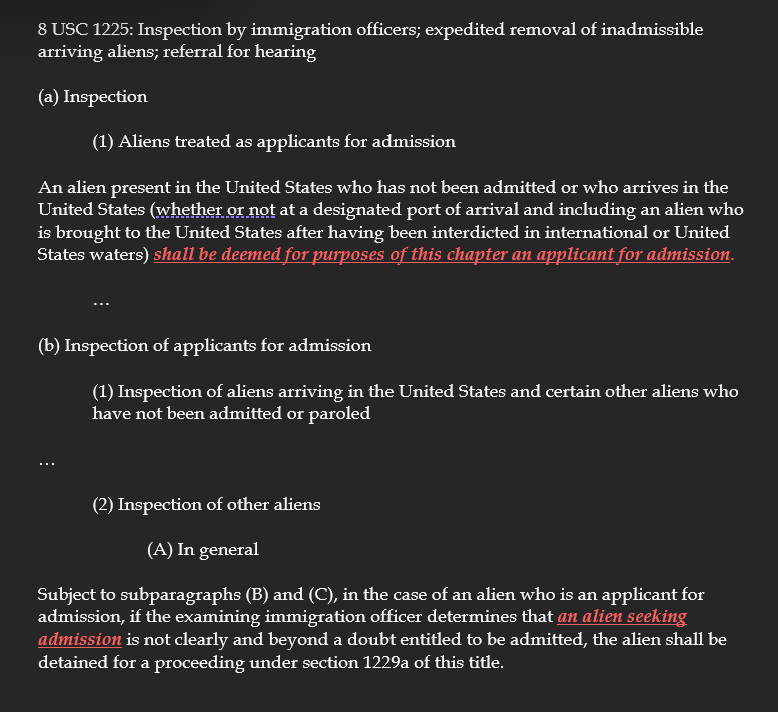
Last Friday, the Fifth Circuit held that many immigrants arrested inside the U.S. after unlawful entry can be treated as “applicants for admission” under the Immigration Code and can be detained without bond while their removal cases proceed.The opinion has dranw considerable attention as the first circuit-level treatment of an issue that affects about two million people nationwide.

As the majority begins, the specific statutory interpretation issue “while novel is not recondite.” It can be summarized as follows – whether the highlighted language establishes two conditions for detention, or only one that appears in two different places:

Buenrostro-Mendez v. Bondi, No. 25-20496 (Feb. 6, 2026).

In Dentons US LLP v. Stairway Legacy Assets, LP, the Fifth Circuit held that the Dentons law firm was not a third-party beneficiary of a contract  (while also concluding the merits of this point had been forfeited.).

Under Delaware law, a third-party beneficiary must show that the contracting parties intended to benefit the third party, that any benefit was a gift or in satisfaction of a preexisting obligation, and that the intent to benefit was a material part of the contract’s purpose, with courts looking to the contract’s language to discern that intent. .

The contract did not identify Dentons or its predecessor, and the claimants did not  “facts which could reasonably lead to the inference” that the parties intended to benefit Dentons, not crediting an argument about the general “Net Revenues” definition in the contract. No. 25-40235; Feb. 2, 2026

McLemore v. Lumen Technologies held that the district court abused its discretion by dismissing a securities complaint with prejudice, without explaining why amendment would be futile, emphasizing that the default practice is dismissal without prejudice or liberal leave to amend. Specifically, the Court noted that Rule 15(a)(2) “evinces a bias in favor of granting leave to amend,” and that an initial Rule 12(b)(6) dismissal should ordinarily be without prejudice unless it is clear the defects are incurable. The Court declined to opine on the merits of the securities claims. No. 25-30264; Jan. 30, 2026.

With most high-profile public-law litigation in the Second and Ninth Circuits at present, the recent “Venue Wars” have cooled off, but venue disputes persist. In In re Trubridge, Inc., the Fifth Circuit found no clear abuse of discretion in denying a transfer motion, even though a forum-selection clause referred to Alabama courts.

The Court concluded the clause was unenforceable because Louisiana has a strong public policy barring forum-selection clauses in contracts with public entities, and the plaintiff here—a Louisiana political subdivision—fell squarely within that protectiion. With no forum-selection clause to trigger the Atlantic Marine framework, the district court proceed under Section 1404(a). The Court held the district court “explicitly considered the convenience of the parties and various public-interest considerations but simply concluded that none warranted transfer ….” No. 5-30727; Jan. 30, 2026.

Trinseo Europe GmBH v. Kellogg Brown & Root reviews several important issues of trade-secret law while affirming a JNOV of a $75 million damages verdict; among them, this basic reminder: “[T]rade secret damages—whether measured by a reasonable royalty or lost profits—must, like patent damages, ‘reflect the value attributable to the infringing features of the product, and no more.'” No. No. 24-20460 (Jan. 21, 2026).

Based on confidential discovery material about decades-old abuse allegations from the Archdiocese of New Orleans’s internal investigation—concerning a priest not listed on the public “Credibly Accused List” and not named in any proof of claim—an attorney texted a high school principal to confirm the priest still served as chaplain and then emailed a reporter naming the priest, identifying his employment, and urging the reporter to “[k]eep this guy on your radar.”

Enforcing a protective order and affirming the trial courts’ substantial sanction on the attorney, Trahant v. Unofficial Committee holds that even if a person’s name or workplace are publicly knowable, linking that person to non-public abuse allegations learned through discovery is confidential under that order, and may not be disclosed absent consent or a court order. Emphasizing the protective order’s specified mechanism for challenging confidentiality designations, the Court rejected the notion that perceived “over-classification” permits unilateral disclosure, noting the proper course is to seek declassification from the court before dissemination.

As to remedy, the Court afirmed a compensatory fee award under Rule 37(b)(2) as a proportionate remedy tailored to the expenses caused by the violation. The amount was supported by invoices and a trustee report that the bankruptcy court expressly considered, and the award reflected a roughly 50% reduction from the total costs to ensure the sanction was no more severe than necessary to deter and redress the misconduct. No. 23-30466, Jan. 2, 2026.

The ghost of Edward Young (right) inspired a vigorous debate about the scope of the doctrine named for him in La Union del Pueblo v. Nelson (and two consolidated, related cases). A Ffth Circuit panel majority held that it had collateral-order jurisdiction to review the denial of sovereign immunity in a dispute about a Texas election law, concluding that  the Secretary of State may be sued as to provisions that she directly operationalizes (such as the DPS data-matching and registrar sanction regime, and the official forms and tools that local officials must use for mail voting and voter assistance). It barred suits against the Secretary for provisions enforced by local actors or dependent on prosecutorial discretion. Standing was satisfied for the surviving claims because the Secretary’s form-setting and registrar-sanction roles are causally connected to the alleged injuries and judicial relief would redress them at least in part.

A dissent would have dismissed the entire case, arguing the Court’s Ex parte Young jurisprudence has become a “No Nexus Rule” that dispenses with any enforcement connection between the named defendant and the plaintiff. No. 22-50775 (Dec. 31, 2025).

Emboldened by the Supreme Court upholding age verification for adult sites in Free Speech Coalition, Inc. v. Paxton, 606 U.S. 461 (2025),Texas chose to impose age-verification requirements for online app purchases. A district court enjoined that law and its ruling is now on appeal to the Fifth Circuit.

Specifically, in Computer & Communications Industry Ass’n v. Paxton, the district court held thatTexas’s SB 2420 is a content-based regulation of speech subject to strict scrutiny. The court noted that the statute’s coverage turns on what speech is provided by an app—exempting, for example, nonprofit apps offering emergency services or standardized testing—and thus “defin[es] regulated speech by particular subject matter.” It distinguished the adult-entertainment law by describing SB 2420’s sweeping restrictions across virtually all apps, including ones involving constitutionally protected news, education, and entertainment.

Applying strict scrutiny, the court held that the statute is overbroad and underinclusive—blocking minors from virtually all apps, even while the same content remains available through preloaded browsers or offline channels—and Texas offered no evidence that most covered apps cause the harms the State invoked. The court also noted less speech-restrictive alternatives, such as education and voluntary tools, rather than mandating universal age verification and individualized parental consent for all downloads and in-app purchases. No. 1:25-cv-01660-RP (W.D. Tex. Dec. 23, 2025.

In Ramirez v. Granado, a Fifth Circuit panel reversed a summary judgment on qualified immunity in a police-shooting case, producing a vigorous dispute between a concurrence and dissent.

The majority found genuine issues for trial, reasoning that a jury could infer that the decedent posed no immediate threat when the fatal shots were fired as he fled with his back turned. It highlighted that, after an initial miss, the officer fired six more rounds “without warning,” four striking “the back of [the decedent’s] head and shoulders,” and then asked, “did he have a gun?”—evidence a jury could use to reject a claim of an imminent threat. erception..

The dissent read the relevant videos and radio traffic as yielding one, dispositive narrative: “Here are the undisputed (and indisputable) facts,” including a 120‑mph chase into a residential area, an “armed and dangerous” advisory, the suspect “holding a gun,” and an eight‑second window from “he has a gun!” to the final shot—concluding that denying qualified immunity is “wrong.” It deemed the “did he have a gun?” remark “astonishingly irrelevant” because the officer learned the occupants were armed and dangerous and nothing “suggest[s] Officer Granado was lying.”

Legally, the majority (and concurrence) emphasize the “totality of the circumstances,” the predominance of the threat‑of‑harm factor once deadly force is used, and that a jury could find the justification had “ceased” by the time shots were fired at a suspect running away. The concurrence added that the dissent’s “mile‑wide” citations involve “overt‑threat” or “furtive‑reach” cases that don’t fit this record, when viewed favorably to the plaintiff (as it saw the record, showing continuous visual contact, no commands to disarm, no pointing, and back‑to‑front wound paths).

The dissent, based on its view of the video/radio evidence, reasoned that qualified immunity applies absent a case “that squarely governs” these “specific facts”: “It is the majority, the concurrence, and [the plaintiff’s] job to point to a case that squarely governs this one. It is not mine.” The dissent cited two Fifth Circuit opinions about firearms that it saw as “materially indistinguishable” from the facts of this case.

En banc review seems likely; serious consideration of en banc review, a certainty. No. 24-10755; Dec. 10, 2025.


The Fifth Circuit denied en banc review of ExxonMobil v. NLRB, a dispute about the NLRB’s decision to vacate an earlier decision and retry the matter (decried by Exxon as a political maneuver; defended by the NLRB as the result of a conflict for a board member involved in the earlier proceeding). A dissent from the denial of en banc review states the case against excessive “independence” for independent agencies, and also has some observations about party-presentation as applied to the evolution of the parties’ arguments during this long-lived case. No. 23-60495 (Dec. 17, 2025).

Inspired by a recent Seventh Circuit case involving similar facts (and the benefit of jurisdictional discovery), the Fifth Circuit reheard Ethridge v. Samsung and concluded that there was not personal jurisdiction in Texas over the plaintiff’s claim to have been injured by a flammable battery made by Samsung.

The new opinion summarizes: “Nothing in this opinion should be construed as answering whether the precise measures Samsung took to sell its products only to the industrial market create a necessary baseline for specific personal jurisdiction cases like this one. It is enough to say that Samsung affirmatively limited its contacts to approved manufacturers in Texas, and Ethridge has not shown that his injuries are related to those contacts.” No. 23-40094 (Dec. 15, 2025, on rehearing).

Wang challenged the constitutionality of a Texas law that restricts certain property acquisitions by persons domiciled in China. His claim failed for lack of standing: “We hold Wang lacks standing because he fails to allege an injury-infact. That’s for two independent reasons. The first reason (A) is that SB 17 does not arguably proscribe Wang’s conduct because he has failed to allege that he is domiciled in China. And the second reason (B) is that Wang has not alleged a substantial threat of future enforcement by the Attorney General.” Wang v. Paxton, No. 25-20354 (Dec. 11, 2025).

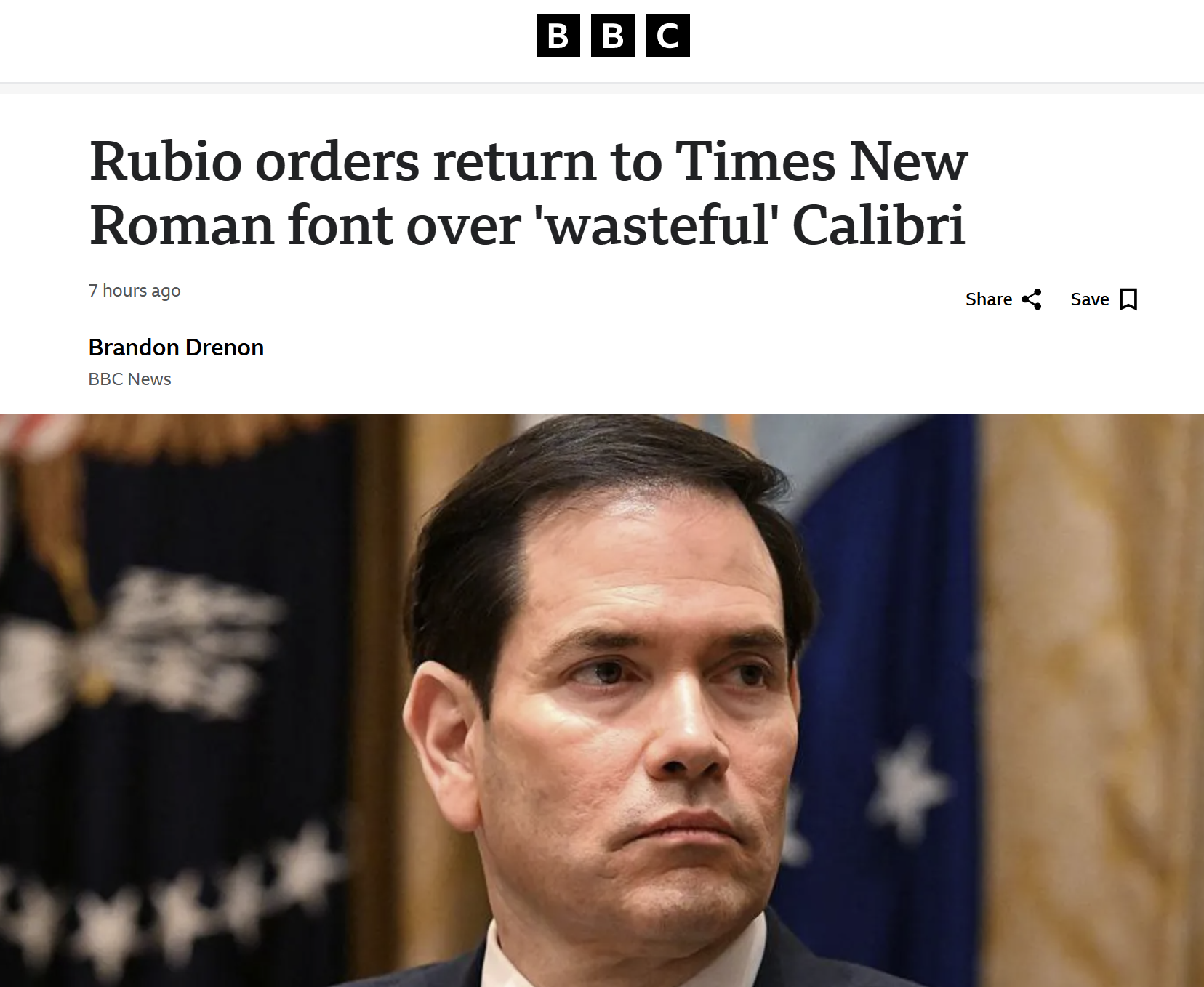
Font selection has global consequences, as the State Department returns from Calibri to Times New Roman (imho, the State Department should jettison both fonts and use a tasteful modern serif font, such as Equity or Book Antigua).

The reticulated python (right) can be found in South Asia. A “reticulated statute” was at issue in Baylor All Saints Medical Center v. Kennedy, in which the Fifth Circuit concluded that the district court had no jurisdiction to hear a Medicare-reimbursement dispute when agency review had not been exhausted. The Court noted: “To be sure, a court may waive the administrative exhaustion requirement if administrative remedies would be exhaustive … Howeer, the court does not reach [that issue]  because the case does not satisfy the ‘jurisdictional requirement that claims be presented to the agency.'” No. 24-10934 (Dec. 9, 2025).

In T&W Holding Co. v. City of Kemah, the Fifth Circuit held that challenges to a municipal “zero-occupancy” order were ripe because the City had already taken a sufficiently final position by issuing the relevant notice, which immediately barred all use of the building.

Rejecting the district court’s view that a further City Council decision was required, the court emphasized that de facto finality exists where the government’s action leaves no doubt as to how the regulation applies to the property: “The City reached a sufficiently final position when the alleged taking occurred—specifically, when Shoaf issued the zero-occupancy notice,” and “[a]s soon as Shoaf posted the zero-occupancy notice, Plaintiffs lost all economic use of the building.” No.
24-40679; Nov. 21, 2025

Computer Sciences Corp. v. Tata Consultancy Services reformed a trade-secret injunction to better match the substantial damages that were also awarded. In particular, the Fifth Circuit held that where a plaintiff has already received unjust enrichment damages—calculated here as avoided development costs—the injunction cannot also bar the defendant’s future use of the technology it built during the misappropriation

The Court recognized two, related principles: (1) unjust enrichment damages are designed to strip the defendant of the benefit accrued from misappropriation and put the defendant in the position it would have occupied had it incurred those development costs lawfully; (2) an injunction cannot then deprive the defendant of the very fruits it has now effectively paid for, because that would be duplicative and punitive.

In other words, once the defendant has been compelled to pay the avoided costs, equity does not also forbid use of the resulting post-misappropriation implementation. Equity does, however, continue to forbid any possession, access, or use of the trade secrets themselves.

The Cout also required the injunction to be conformed to Federal Rule of Civil Procedure 65(d)(2), to clarify that the scope of the specific parties bound by the injunction was consistent with the terms of that rule. No. 24-10749; Nov. 21, 2025.

If you aren’t yet a member of the Bar Association of the Fifth Federal Circuit (or “BAFFC” to those in the know) you should join! Our gifted new executive director, Donna Cuneo, led the charge for this awesome new publication, “Following the Fifth” that has general news and also highlights the great work of Krystil Lawton and Walter Woodruff — here is the first edition!


Storey Mountain LLC v. JP Morgan Chase laments: “Despite the long line of cases requiring parties to establish the citizenship of an LLC’s members, this remains ‘an evergreen problem in our circuit.'”

The Court thus remanded for further development of the record about the parties’ citizenship, reminding that the following was not sufficient to establish diversity jurisdiction as to an LLC: “Storey Mountain LLC ‘is a limited liability company organized under the laws of Wyoming, with its principal place of business in Florida. For purposes of diversity, Garnishor is a citizen of Wyoming and Florida.” No. 24-20535 (Nov. 10, 2025).


The interlocutory appeal in Arnold v. Barbers Hill ISD arose from a challenge to a school district’s hair-code policy. The plaintiffs noticed depositions of the superintendent and a former board president to probe the Board’s reasons for adopting and enforcing the policy. The district asked the court to bar questions about lawmakers’ “subjective intentions, motivations, [and] thought processes” by invoking legislative privilege on their behalf.

The Fifth Circuit held that legislative privilege is “personal to the legislator,” and observed that no individual privilege holder had actually invoked it or otherwise participated in the proceedings. Therefore, the governmental entity could not assert it on their behalf. As the Court concluded: “This case’s cart precedes its horse.” No. 23-20256, Nov. 3, 2025.

In Legendre v. Harrah’s Casino, the Fifth Circuit held that a genuine fact issue existed as to negligence, requiring reversal of a summary judgment, where surveillance footage and testimony allowed a reasonable inference of inattentive conduct by an employee.

A patron of Harrah’s Casino bumped into a casino employee on the casino floor. The record showed that  the employee admitted he “was walking while looking down fixing [his] facemask” and did not see the patron before impact.. A surveillance video, while brief, showed him not looking where he was going. As the Court summarized: “whether this momentary inattention amounts to negligence is a fact issue, which the district court should not have resolved.” No. 24-30689, Oct. 30, 2025.

Ackerman v. Arkema involved the rule of orderliness and a question of Texas limitations law about the tolling effect of a class-action filing. Anchoring its analysis in prior Circuit precedent, the panel majority said that, absent intervening state authority, it must adhere to earlier panel decisions predicting Texas law, because “a prior panel’s interpretation of state law has binding precedential effect on other panels of this court absent a subsequent state court decision or amendment rendering our prior decision clearly wrong.”

That said, the panel divided over whether to certify the tolling question to the Texas Supreme Court. The majority declined to do so, emphasizing that neither party pressed for it, that one side opposed it at argument while the other was tepid, and that the issue did not present a “close[] question” in light of Circuit precedent. The dissent would have certified. No. 25-20006, Oct. 31, 2025.

The arcane but still vital “strips and gores” doctrine of Texas property law appeared in Legacy Housing Corp. v. City of Horseshoe Bay, in which the Fifth Circuit held that doctrine did not award the developer ownership of a five-foot “greenbelt” strip, because the original grantor conveyed lots by express reference to a recorded plat that mapped each lot’s boundary and the contiguous greenbelt as separate. “Texas’s strips and gores doctrine does not apply to unambiguous conveyances unless the case involves a road or right of way,” and the greenbelt here was neither. No. 24-50462; Oct. 31, 2025.

Jones v. City of Hutto reversed a judgment for a former mayor based on 42 § 1981, while also describing the limits for municipal liability for breach of contract claims,

On the contract issue, the Court noted that the Texas Local Government Code waives governmental immunity for certain written contracts, permitting a breach claim against a city, and held that a municipality’s attempted rescission of a valid separation agreement constituted a breach even where the employee retained the severance payment. At the same time, the Court reminded that Section 271.153(b) bars recovery of consequential damages such as lost profits or reputational harm. Here, the plaintiff “pursued and prevailed on his right to retain the separation payment made under the contract,” which was sufficient to support a potential award of attorney’s fees, but not to open the door to consequential losses.

The Court also clarified attribution principles relevant to contract liability. Disparaging statements by individual councilmembers did not establish breach by the municipality because they were not actions of the city or the council as a body; conversely, a formal council resolution purporting to rescind the agreement was attributable to the city and was the breach that impaired contractual rights. No. 24-50096, Oct. 7, 2025.

In Lewis Brisbois Bisgaard & Smith LLP v. Bitgood, the Fifth Circuit vacated statutory damages awarded under the Lanham Act, remanding because the district court did not explain the statutory basis for its award in light of a gap in registration for the primary mark at issue. The panel rejected the argument that a prior panel’s footnote foreclosed statutory damages, characterizing that statement as dicta.

Central to the ruling was the Court’s recognition that statutory damages under 15 U.S.C. § 1117(c) require infringement of a registered mark under § 1114(1)(a). Because the “Lewis Brisbois Bisgaard & Smith” registration had lapsed during the relevant period, the panel concluded it could not assess whether the award could be sustained by other, similar registered marks allegedly “identical with, or substantially indistinguishable from,” the misused name. The Fifth Circuit also directed the district court to address a Seventh Amendment issue on remand. No. 24-20458, Oct. 23, 2025

Rose v. Aaron held that a damages award could not stand because it did not reflect restitution, reliance, or expectancy damages and lacked the necessary methodology to measure the plaintiff’s economic position had the contract been performed.

Specificaly, the Fifth Circuit that a damages award based on the cost of improvements to a ranch were not restitution (no benefit conferred on the breaching party), not reliance (expenditures were not made toward performing the contract), and not expectancy because the factfinder neither offset avoided costs nor quantified other claimed harms with objective evidence.

On expectancy damages in particular, the court faulted the absence of proof that the harms from the breach exceeded the gains the nonbreaching party realized by avoiding future performance, leaving the award ambiguous as to whether it placed the claimant in a better, equal, or worse position than full performance. No. 21-40718 (Oct. 17, 2025).

Hignell-Stark v. City of New Orleans returns to the seemingly evergreen topic of short-term rental regulation by the City of New Orleans. These are some of the holdings reached:

  • Equal Protection. The Fifth Circuit struck down the City’s categorical ban on business entities holding owner or operator permits. Because natural‑person owners and juridical‑person owners are similarly situated for purposes of STR permitting, the City’s prohibition on business‑held licenses could survive only if it bore a rational relationship to a legitimate governmental interest. The court found none. The City’s livability and neighborhood‑character concerns relate to guest conduct and on‑site oversight, not the legal identity of the permittee.And the Court disagreed that corporate form would impede enforcement or increase administrative burdens, noting that the Code already limits concentration through one‑permit‑per‑block and one‑permit‑per‑person rules.
  • First Amendment. The Court distinguished between permissible disclosure requirements and impermissible content restriction. It upheld requirements that STR ads include factual, uncontroversial information such as permit numbers, accessibility details, and bedroom/occupancy counts, as well as prohibitions on advertising unpermitted or over‑capacity rentals. By contrast, the rule that “each short‑term rental listing advertises only one dwelling unit” failed, because the City did not say how the “one‑unit‑per‑ad” limitation directly advances a substantial interest or why it is no more extensive than necessary, and the Curt declined to supply post hoc justifications.

No. 24-30160; Oct. 7, 2025

OSR Enterprises AG v. REE Automotive, Ltd. affirmed the district court’s conclusion, in a forum non conveniens analysis, that Israel is an adequate alternative forum for a trade-secret dispute:

  • Extraterritorial injunctive relief: Faced with competing expert declarations about whether Israeli courts would issue extraterritorial injunctions for trade-secret misappropriation, the Fifth Circuit concluded the evidence did not show Israel would leave the plaintiff with “no remedy at all.” The plaintiff’s showing of what is “very likely” under Israeli law, disputed by the defense expert, was insufficient to rebut adequacy.
  • Availability of unfair competition relief: Even assuming some uncertainty about Israel’s Commercial Torts Law, the Court held that adequacy does not require identical causes of action or relief. Because Israeli law recognizes trade secret misappropriation and would provide some remedy, Israel remained adequate even if certain claims might be limited.
  • Self-incrimination privilege and access to evidence: The Court also rejected the argument that Israeli witnesses’ potential invocation of a self‑incrimination privilege undermines adequacy, noting that adequacy typically turns on whether remedies are clearly unsatisfactory, rather than evidentiary privileges. The Court also noted that key third-party witnesses are in Israel and would likely be beyond the compulsory process of a U.S. court, undercutting claims that American proceedings would materially improve access.

No. 24-50779; Oct. 10, 2025.

Stone v. Graham, 449 U.S. 39 (1980), holds:

“Posting of religious texts on the wall  serves no such educational function. If the posted copies of the Ten Commandments are to have any effect at all, it will be to induce the schoolchildren to read, meditate upon, perhaps to venerate and obey, the Commandments. However desirable this might be as a matter of private devotion, it is not a permissible state objective under the Establishment Clause.

Consistent with that precedent, in Roake v Brumley, a Fifth Circuit panel affirmed an injunction against a Louisiana law requiring the display of the Ten Commandments in school classrooms, Nevertheless, the full Court has voted to take the case en banc (interestingly, a somewhat overheated effort to get immediate en banc review of this case was rejected 14-3 soon after the trial court’s ruling was appealed.

A challenging administrative law issue, about certain airline fee-disclosure requirements, produced a panel opinion that agreed with FAA’s authority but remanded for consideration of new information. The Fifth Circuit recently voted to take the case en banc.

A Louisiana statute requires that cancellation of an insurance policy be done in a certain way; the Fifth Circuit affirmed judgment for the insurer in Williams v. GoAuto Ins. Co.: “What is necessary prior to cancellation is that the insurer had “receipt” of notice of cancellation sent by the premium finance company. … This is a modern statute set in current times, and company computers do much that individuals once did. GoAuto’s method of receiving the notice and reacting to it satisfies the statute.” No. 24-30646 (Oct. 3, 2025).

Providing fuel both to those who argue (a) that the claimed invasion of the United States by rogue Venezuelans is not, in fact, a high-priority item on the national agenda, and also to those who argue that (b) that the judiciary moves too deliberately to meaningfully engage questions of national security, the Fifth Circuit has voted to rehear en banc the case of W.M.M. v. Trump, about the President’s power to order certain deportations under the Alien Enemies Act.

Returning to the Fifth Circuit after the Supreme Court rejected the Circuit’s “moment-of-threat” doctrine, the panel in Barnes v. Felix now applied a totality-of-the-circumstances analysis.

The Court considered the events leading up to the shooting: the deputy stopped a vehicle for outstanding toll violations, and during the stop, the driver ignored commands, grabbed his keys, and attempted to flee by driving away on a busy freeway. The deputy, partially inside the moving vehicle, fired his weapon as the car accelerated. The Court held that the deputy’s use of deadly force did not violate the Fourth Amendment because his conduct was not objectively unreasonable given the immediate risks to himself and the public posed by the suspect’s sudden flight.

On that basis, the Court applied qualified immunity, concluding that “the plaintiffs have failed to satisfy the first step of the qualified-immunity analysis—raising a dispute of material fact on whether [the decedent’s] Fourth Amendment right to be free from excessive force was violated ….” No. 22-20519, Sep. 18, 2025.

The first two paragraphs elegantly place this dispute within many decades of the legal system’s interaction with the automobile:

“As advances of the genre of the Morse code, with its twenty-six letters and ten numerals, railroads, and flight challenged the social order and perforce its legal regime, today we repair to the horseless carriage with its then unimaginable role in daily life, and as with each of the past challenges to the essential task of policing its usage.

From a unanimous Supreme Court came pretextual stops, enabling police officers to stop an automobile upon probable cause that any traffic violation has occurred, even if the stop is in search of another violation. Even before that, the Court, aware of the “inordinate risk confronting an officer as he approaches a person seated in a vehicle,” had granted officers the right to order the driver out of the vehicle. The import of these decisions cannot be understated, as traffic stops are among the most common interactions the public has with police.” (citations omitted)

In State of Texas v. EPA, the Fifth Circuit upheld the EPA’s authority to substantively evaluate and disapprove a State Implementation Plan under the Clean Air Act’s Good Neighbor Provision. The court confirmed that EPA may require SIPs to address both “significant[] contribut[ion] to nonattainment” and independent “interfere[nce] with maintenance” in other states, including areas not formally designated nonattainment, and emphasized that “The text puts EPA in the driver’s seat for evaluating a SIP’s compliance with the CAA.”

The court also approved EPA’s reliance on up-to-date interstate transport modeling and a 2017 projection year as reasonable, reiterating that “nothing in the statute places the EPA under an obligation to provide specific metrics to States before they undertake to fulfill their good neighbor obligations.” Because Texas’s SIP lacked analysis quantifying downwind impacts and ignored maintenance receptors, EPA’s disapproval was neither arbitrary nor capricious. 16-60670; Sept. 22, 2025. A dissent would vacate the EPA’s action for missing the 12-month deadline established by a statute.

I&I Hair v. Beauty Plus The Fifth Circuit rejected a takings claim against the City of Mesquite when that claim arose from the “alleged ‘thwarting of [plaintiffs’] previously approved development and reimbursement rights” governed by their contracts with the City and the Management District.”

The plaintiffs argued that the City had to have acted in its sovereign capacity because “only a governmental entity acting in its governmental or sovereign capacity can change the regulations and rules mid-stream ….”

The Court disagreed: “Although only government entities can alter a regulatory scheme, any party to a contract may attempt—or refuse—to renegotiate the terms of an
agreement midstream. In such circumstances, any resulting dispute is contractual. That conclusion does not change merely because the party is a governmental entity.”

Mesquite Asset Recovery Group v. City of Mesquite, No. 24-11025 (Sept. 23, 2025).

In WorldVue Connect Global, LLC v. Szuch, the Fifth Circuit largely upheld a preliminary injunction enforcing one-year non-solicitation and confidentiality covenants arising from a business sale, whille narrowing the confidentiality restraint. It addressed these specific matters:

  • Geographic scope: The non-solicitation covenant applies to recruiting employees and contractors who perform work in the Restricted Area, even if they live and work abroad, aligning the covenant with contact language about “supporting … networks in the Restricted Area.”
  • Covered personnel: Workers supplied through staffing agencies can still be “independent contractors” of the buyer and are within the covenant’s protection.
  • Specific hires: Barring the hiring of eleven named contractors was proper given evidence they had already been solicited and to prevent the breaching party from reaping the benefit of the breach.
  • Confidential information: The court modified the injunction to exclude the seller’s pre-existing personal knowledge of worker identities: “The term ‘confidential information’ … does not include the Szuch Group’s personal knowledge regarding the identity of personnel who worked for or with WorldVue.” Company-developed information (e.g., assessments of skills and value created after the 2022/2024 transactions) remains protected.

The Court also affirmed as to the trial court’s assessment of other equitable factors related to injunctive relief. No. 24-20571, Sept. 16, 2025

The Fifth Circuit waived goodbye (for now) to the long-lived dispute of Abraham Watkins v. Festeryga, concluding that the defendant did not waiver his right to remove to federal court. The Court concluded that “the district court committed two legal errors in concluding that Festeryga waived removal.”

First, the district court erred in reading Circuit precedent to establish “a supposed bright line rule: filing any motion to dismiss automatically invokes state-court jurisdiction.” The TCPA motion filed by Festeyga was never set for hearing, or ruled upon, and the filing of the motion had collateral effects (a discovery stay).

Second, the discovery stay created by filing the TCPA motion was not a waiver: “Halting discovery is the quintessential act of preserving the status quo until a new forum takes over.” No. 23-20337 (Sept. 11, 2025).


McRaney v. N. Am. Mission Board arises from a contentious dispute between the North American Mission Board, a Baptist organization, and the former executive director of the Baptist Convention of Maryland/Delaware (“BACM”). He alleged that the Board interfered with his employment relationship with BACM; the Board argued that it was protected by ecclesiastical immunity.

The case produced two difficult and intertwined legal issues: (1) the application of ecclesiastical immunity to the sprawling, decentralized structure of the various affiliates of the Southern Baptist Convention, and (2) the application of facially neutral tort principles to a job position with both secular and religious responsibilities (put another way, the plaintiff had to render unto both God and Caesar to do his job effectively). The panel majority presents some examples of the difficulty with the second issue:

“When a secular court considers the SPA, how should it determine if McRaney succeeded in ‘penetrating lostness,’ ‘making disciples,’ and ‘church planting’? Can a secular court determine whether NAMB’s conduct was the ‘proximate cause’ of BCMD’s decision to terminate McRaney, without unlawfully intruding on a religious organization’s internal management decisions? And can a secular court decide it was ‘false’ that McRaney’s leadership lacked Christ-like character?”

(citation omitted).

Echoing a close en banc vote after the denial of a motion to dismiss earlier in this litigation, the panel split 2-1, with the majority resolving the above issues in favor of the Board, and a dissent, in favor of the former director. No. 23-60494 (Sept. 9, 2025).

Attorneys who represent religious organizations should treat the majority opinion as a “compliance guide” to ensure that their organizations’ practices receive the full protection to which they may be entitled.

Fugedi v. Initram, Inc., addresses whether a litigant can create diversity jurisdiction by purporting to convey title to property in an out-of-state trustee. The Fifth Circuit concluded that 28 U.S.C. § 1359 bars this maneuver, holding that the statute’s prohibition on parties “improperly or collusively made or joined to invoke the jurisdiction of such court” applies with equal force to trusts.

The panel emphasized that limiting language—“by assignment or otherwise”—sweeps broadly enough to reach trusteeship arrangement. “Nothing in those words excludes the use of a trust,” observed the Court, and permitting such a tactic would sanction precisely the “manufacture of Federal jurisdiction” Congress meant to foreclose.

Applying that reading, the Court held that this trustee was a “sham” selected solely because his non-Texas citizenship would create complete diversity in a purely local real-property dispute. The record showed that the trustee had no meaningful role beyond litigation, lacked relevant expertise, and was installed mere weeks before suit. No. 24-40283, Sept. 9, 2025.

The Fifth Circuit reinstated a jury verdict, set aside by the trial court as unsupported by sufficient evidence, in I&I Hair v. Beauty Plus. The case involved unfair-competition claims about synthetic hair braids.

The district court opinion identified, inter alia, problems with (1) whether the plaintiff presented adequate evidence of its own lost-profit damages (i.e., evidence about business expenses and overhead, to avoid overreliance on informatoin about gross revenue and profit margin), and (2) whether the plaintiff inappropriately asked the jury to equate defendants’ profits with the plaintiff’s lost profits, without sufficient evidence that I&I would have captured all those sales.

The Fifth Circuit held that the jury had a sufficient foundation for its damages award, reminding generally that “[plainitff] had to provide evidence that would permit an award; it does not have to substantiate the specific figure the jury awarded.” No. 24-10374 (Sept. 5, 2025).

In La Union del Pueblo Entero v. Abbott, the Fifth Circuit examined organizational standing as to three sets of claims about Texas Senate Bill 1’s voter-assistance rules.

  1. No plaintiff organization had standing to challenge the statute’s new disclosure requirements for ballot-assistors. Fears that volunteers might be prosecuted for filling out the form incorrectly were “speculative” and “depend on a ‘highly attenuated chain of possibilities.’” Because there was no credible threat of enforcement, the court said the alleged chill on recruitment, the reallocation of staff time, and the need to educate volunteers were all self-inflicted setbacks that “do not suffice to establish injury in fact.”
  2. The same held true for a challenge to the revised oath assistors must swear. The organizations argued the additional “penalty of perjury” language scared off helpers. The court was unpersuaded, emphasizing that the oath merely clarified duties that were already on the books and repeating that “[p]laintiffs ‘cannot manufacture standing merely by inflicting harm on themselves based on their fears of hypothetical future harm that is not certainly impending.’”
  3. The court found osome rganizational standing for SB 1’s two compensation bans. One provision criminalizes paying—or being paid—for helping a voter complete a mail ballot. Another criminalizes compensated “vote harvesting” in the presence of a ballot. Two groups showed that their staff are routinely paid to provide exactly the kind of assistance the statute forbids and that they intend to keep doing so. Because the State had not disavowed prosecutions, the threat of enforcement was sufficiently concrete, imminent, and traceable to the defendants to confer standing.

No. 24-50826 (Aug. 29, 2025).

Salvador Dali mused about the malleable nature of time in his painting The Persistence of Memory.

Similarly, a Biden-era dispute between the Texas and federal governments, addressing an aggressive state statute about immigration enforement, was resolved by a 2-1 panel opinion in favor of federal preemption in United States v.Texas.

Despite the change of Administrations–and with it, a massive budget increase for ICE that drastically expanded federal immigration enforcement–this Biden-era remannt will now be reheard en banc later this year or early next.

The panel majority in Spectrum WT v. Wendler concluded that a student-organized drag show is protected expressive conduct under the First Amendment. The court emphasized that theatrical performance “plainly involve[s] expressive conduct,” and that in the context of an LGBT+ charity event, the show’s message of solidarity was “unmistakable.”

Because the university’s auditorium was opened to a wide range of outside speakers and events, the panel classified it as a designated public forum; banning drag shows was therefore a content-based restriction subject to strict scrutiny. The majority found no compelling justification for that ban, noting that the school already had time-, place-, and manner rules to police lewd conduct and that “a pointed expression of solidarity” could not be suppressed simply because administrators disliked the medium chosen.

The majority summarized: “[T]his drag show would convey such a message. That is enough to implicate the First Amendment.” A dissent would defer to the university administration. No. 23-10994, Aug. 18 2025.

Fire Protection Service, Inc. v. Servitec addressed whether several key terms in the “Texas Fair Practices of Equipment Manufacturers, Distributors, Wholesalers, and Dealers Act ” are ambiguous.

The threshold question was whether the plaintiff engaged in the sale of “equipment” as defined by that statute, which in turn raised the question whether its products–a type of lifeboat–are used by a kind of commercial activity referenced by the statute, and if so, whether their use is “in connection with” that activityu.

As for the type of activity, examining the terms “mining” and “industrial activities,” the Court canvassed dictionaries and long-standing Texas precedent and ruled that each term carries a settled, ordinary meaning broad enough to encompass offshore oil and gas operations, commercial shipping, and similar endeavors.

Turning to the statutory phrase “used … in connection with,” the court again found no textual uncertainty. Citing recent Texas Supreme Court authority, the panel emphasized that the words “in connection with” are inherently expansive and “cannot ‘imply more than a tangential connection’ unless the statute’s text constricts its ordinary meaning.” Because the Act contains no such limiting language, the court held that the statute unambiguously sweeps in equipment—such as life rafts—that bears even a tangential relationship to the covered commercial contexts. Noi. 24-20405 (Aug. 21, 2025).

Anticipatory breach, or the lack of it, was the question in Penthol LLC v. Vertex Energy Operating LLC. Applying Texas law, the panel emphasized that repudiation requires an “absolute and unconditional” refusal to perform, and a trading company’s  letter did not meet that standard–it merely warned that the distributor would terminate the agreement if the manufacturer failed to cure an alleged breach within thirty business days.

Because that warning was both conditional (performance could still be rendered) and prospective (termination would occur only after the cure period), the court concluded it was not a repudiation. As the opinion summarized: “Letter 1 neither constituted nor served as the starting point for a repudiation, because [the] threat of nonperformance was neither absolute nor unconditional.”No. 24-20329, Aug. 14, 2025.

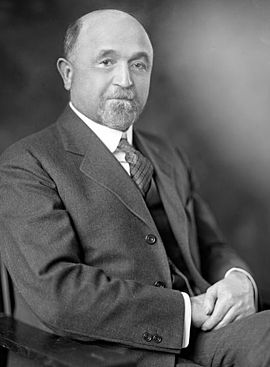
SpaceEx v. NLRB holds that the National Labor Relations Board’s “for-cause” removal protection for its five Members is likely unconstitutional because the Board, unlike the 1935 Federal Trade Commission, “is not a ‘mirror image’ of the FTC.” In the Fifth Circuit’s view, the Board wields extensive executive power—adjudicating unfair-labor-practice charges, directing elections, and petitioning federal courts for injunctions—yet lacks any statutory party-balancing requirement. Those differences place the NLRB outside the narrow safe harbor created by Humphrey’s Executor.

A dissent argued that an injunction should not issue absent proof that the contested provisions actually harmed the employers. No. 24-50627 (Aug. 19, 2025). (Mr. Humphrey appears above; history does not seem to have recorded an image of his executor.)

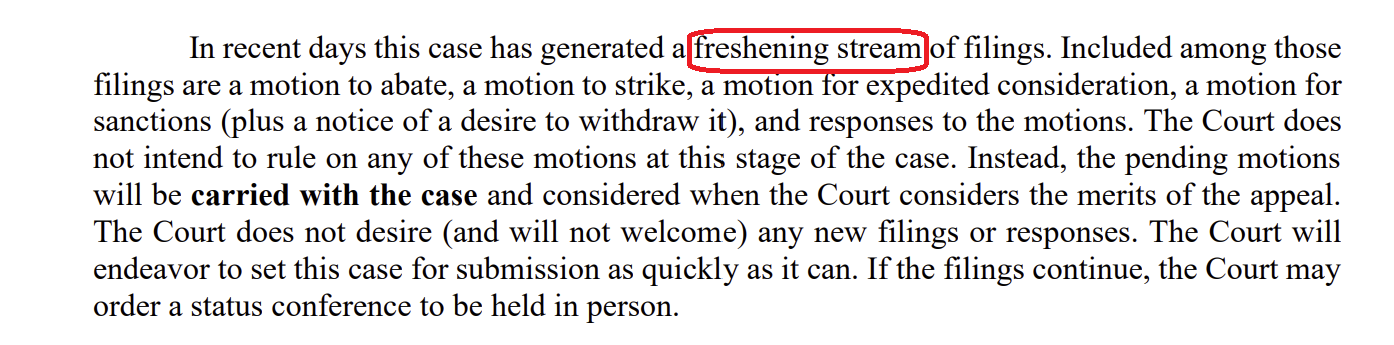
Hon David Gunn of Houston’s First Court of Appeals has given new life to the word “freshening” as an adjective for a frustrating series of court filings (thanks to Ben Taylor for drawing my attention to it):

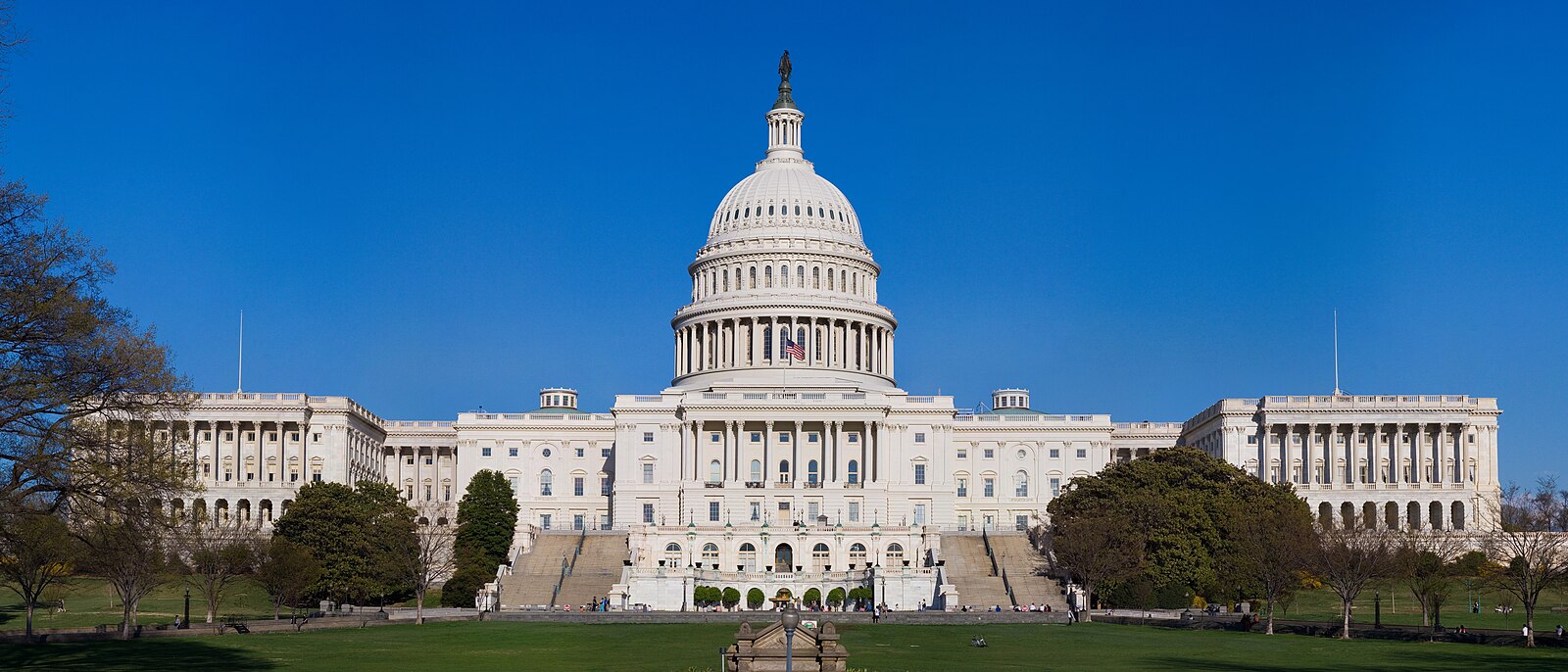
Quorum issues have vexed efforts to have a special Texas legislative session in 2025. Meanwhile, in State v. Bondi, a Fifth Circuit panel majority held that the House may constitutionally count Members who vote by proxy toward a quorum. It reasoned that the U.S. Constitution’s Quorum Clause “does not require physical presence,” emphasizing that the Constitution speaks only of a “majority” and leaves each chamber broad discretion to decide how to “ascertain the fact” of that majority.

Specially, the Court concluded that remote‐participation rules adopted during the pandemic merely supply a permissible method for determining whether enough Members are participating, not a redefinition of the quorum itself. Because the underlying legislative record indisputably showed that more than half the House either voted or authorized a proxy to do so, the court declared that “the Constitution’s text, history, and tradition support remote voting and counting proxies as sufficient for quorum.”

The panel warned that reading the Constitution to demand physical presence would empower a minority to block legislation and “undermine the very purpose of the Quorum Clause: to ensure majoritarian rule.”

A dissent argued that the Quorum Clause’s reference to “compel[ling] the Attendance of absent Members” and more than two centuries of congressional practice show that a quorum exists only when a majority are physically in the chamber. By allowing the House to satisfy the quorum requirement with paper proxies, the dissent argued, the court stripped the Clause of its structural safeguard against minority rule and permitted Congress to “define the Constitution’s quorum requirement out of existence.” No. 24-10386, Aug. 15, 2025,

In DM Arbor Court, Ltd.. v. City of Houston, the Fifth Circuit held that the City’s denial of repair permits under its flood control ordinance constituted a categorical taking under the Supreme Court’s Lucas framework.

After the Arbor Court apartment complex was severely damaged by flooding, the City refused to issue repair permits unless the buildings were elevated to meet new floodplain requirements—a cost the court found to be “prohibitively expensive” and “economically unfeasible.” Both the property owner’s and the City’s experts agreed that, under these conditions, there was “no economically viable, or feasible, or beneficial use of the property.” The Fifth Circuit stated, “Saying that a property’s only remaining use is to hope for future development is the same as saying that the property must remain idle today. That is a categorical taking under Lucas.”

A dissent argued that the district court’s analysis was correct, emphasizing that Lucas takings are reserved for the “extraordinary case” where a regulation “permanently deprives property of all value. No. 23-20385, Aug. 12, 2025

Palms v. Texas Childrens Hospital, a case about religious objections to a flu vaccine, produced a difference of opinion as to whether the plaintiff’s accommodation claim had been forfeited.

The majority held that the plaintiff had forfeited her argument by failing to adequately brief how the district court erred in granting summary judgment, emphasizing that she “never states that TCH’s offered accommodation was unreasonable or explains why the district court could not dismiss her claim on this ground.” Citing established precedent, the majority reasoned that a party forfeits an argument by failing to “offer any supporting argument or citation to authority” or to “identify relevant legal standards and any relevant Fifth Circuit cases.”

The dissent contended that the plaintiff’s opening brief sufficiently challenged the timing and adequacy of the hospital’s accommodation, expressly arguing that the hospital’s delay in granting an accommodation was unreasonable and resulted in her being “impermissibly ‘suspended without pay’ due to her religious beliefs.” The dissent criticized the majority’s approach as a “legal trick-box” that would deprive employees of the ability to pursue meritorious claims of religious discrimination simply because the employer eventually ceased the challenged conduct. No. 24-20174, Aug. 11, 2025

A civilian treatement of contract formation appears in CAM Logistics LLC v. Pratt Indus., Inc., which applied Louisiana law to the question whether parties can be bound to a contract when they have not executed a written agreement, despite ongoing negotiations and partial performance.

The court held that when both parties contemplate a written contract as the form of their agreement, there is a presumption under Louisiana law that they do not intend to be bound until the contract is executed in that form. The presumption applied here because both sides “bargained for a written contract” and took steps such as exchanging draft agreements and seeking legal review, but never finalized or signed any document. ”

The court further rejected the argument that the parties’ performance—such as providing services and making payments—could override the lack of a signed contract (or in civilian parlance, “evidence the intention to cure its relative nullity”). No. 24-30806, Aug. 6, 2025.

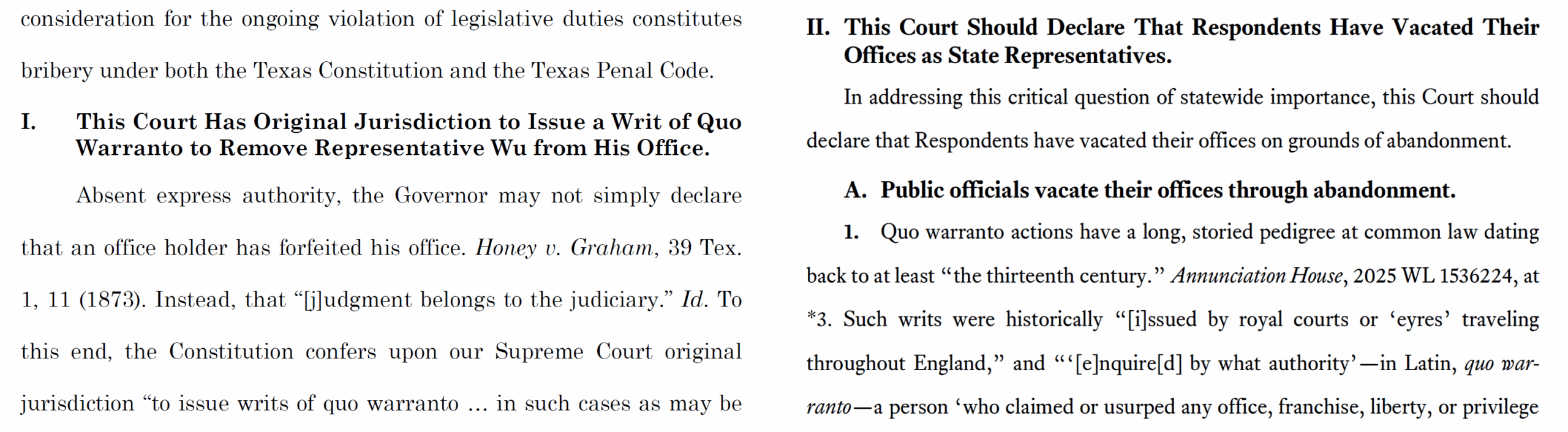
The flight of the Democratic delegation from the Texas House has drawn a great deal of attention. The resulting legal filings in the Texas Supreme Court (Ken Paxton’s here, and these are the petition, response, and reply from the action filed by the Governor) display quality legal writing and excellent font choice. The Governor has chosen a classic look with a Century font, while the Texas Solicitor General uses Equity–generally speaking, a superior font, but perhaps not with the identical margins and spacing that one would use with Century:

Barnett v. American Express rejected a claim that arbitration was waived by substantially invoking the judicial process: “American Express did not substantially invoke the judicial process on Barnett’s FCRA claim by suing to collect her debt. Its previous suit brought only a generic breach of contract claim under Mississippi law. That is undoubtedly a different claim than Barnett’s subsequent FCRA action, which American Express immediately sought to arbitrate.” No. 24-60391 (July 29, 2025).

In Angelina Emergency Medicine Associates v. Blue Cross, the Fifth Circuit addressed the ambiguity of language used in various assignments of benefits, including terms such as “health care providers” or “practitioners providing care and treatment.”

The Court found that these terms were ambiguous as to whether they encompassed physician groups as assignees, noting that the assignments used “plain English for a lay audience” and that the descriptive, role-based language could reasonably be interpreted to include a class of people such as the physicians providing care to the patients. The court observed that there was no clear legal or contractual definition of “provider” in this context, and that the term could refer to both individual doctors and groups of doctors.

The Court further emphasized that the absence of “more precise form-language that explicitly delegates rights to the management entities to which the facility-based physicians belong” does not invalidate the assignment, given the ambiguity present. As a result, the court vacated summary judgment on this issue, holding that the ambiguity in the assignment language created a fact issue that precluded summary judgment. No. 24-10306, Aug. 8, 2025.

In Wright v. Honeywell Int’l, a Title VII case about a COVID vaccination requirement, the Fifth Circuit held (citations omitted):

Viewing the evidence in the light most favorable to Wright and drawing all reasonable inferences in his favor, a reasonable jury could find that Wright held at least a mixed motive for his vaccine refusal: a bona fide religious belief alongside political beliefs and personal preference. Wright’s evidence demonstrates a “moral or ethical” belief in bodily autonomy and freedom to choose what to put in his body.  The fact that he gave additional reasons for his vaccine refusal does not show that his belief is “merely a preferred practice.”  Instead, it simply shows that his vaccine refusal is grounded on both religious and nonreligious reasons. Furthermore, the inquiry on this prong is not “whether [Wright’s specific] belief is a true religious tenet” of the Baptist faith, but rather whether the belief is, “in his own scheme of things, religious.” Because a plaintiff’s sincerity in espousing a religious practice “is largely a matter of individual credibility,”  Wright’s evidence would be better weighed by a jury than by the court at the summary judgment stage.

A footnote considers whether future Supreme Court opinions may exclude “purely moral or ethical beliefs” from the protection of Title VII; cf. U.S. Const. amend. I (creating some tension when guarding against both “respecting an establishment of religion” and “prohibiting the free exercise thereof”).

In the department of “things I did not know before,” I learned about the “federal enclave” doctring from Vinales v. AETC II Privatized Housing, LLC. This “enclave” arose when Texas ceded land to the federal governement for an air base, which had these consequences:

Generally, when an area in a State becomes a federal enclave, ‘only the [state] law in effect at the time of the transfer of jurisdiction continues in force’ as surrogate federal law.” “Existing state law typically does not continue in force, however, to the extent it conflicts with ‘federal policy.’” “And going forward, state law presumptively does not apply to the enclave.”

No. 24-50113 (June 27, 2025) (citations omitted).

Judge Roy Bean famously considered himself to be “The Law West of the Pecos” (right). Judge Bean would have been at home in Jones v. King, a dispute about whether certain would-be voters actually resided in remote Loving County – the least populated county in the US.

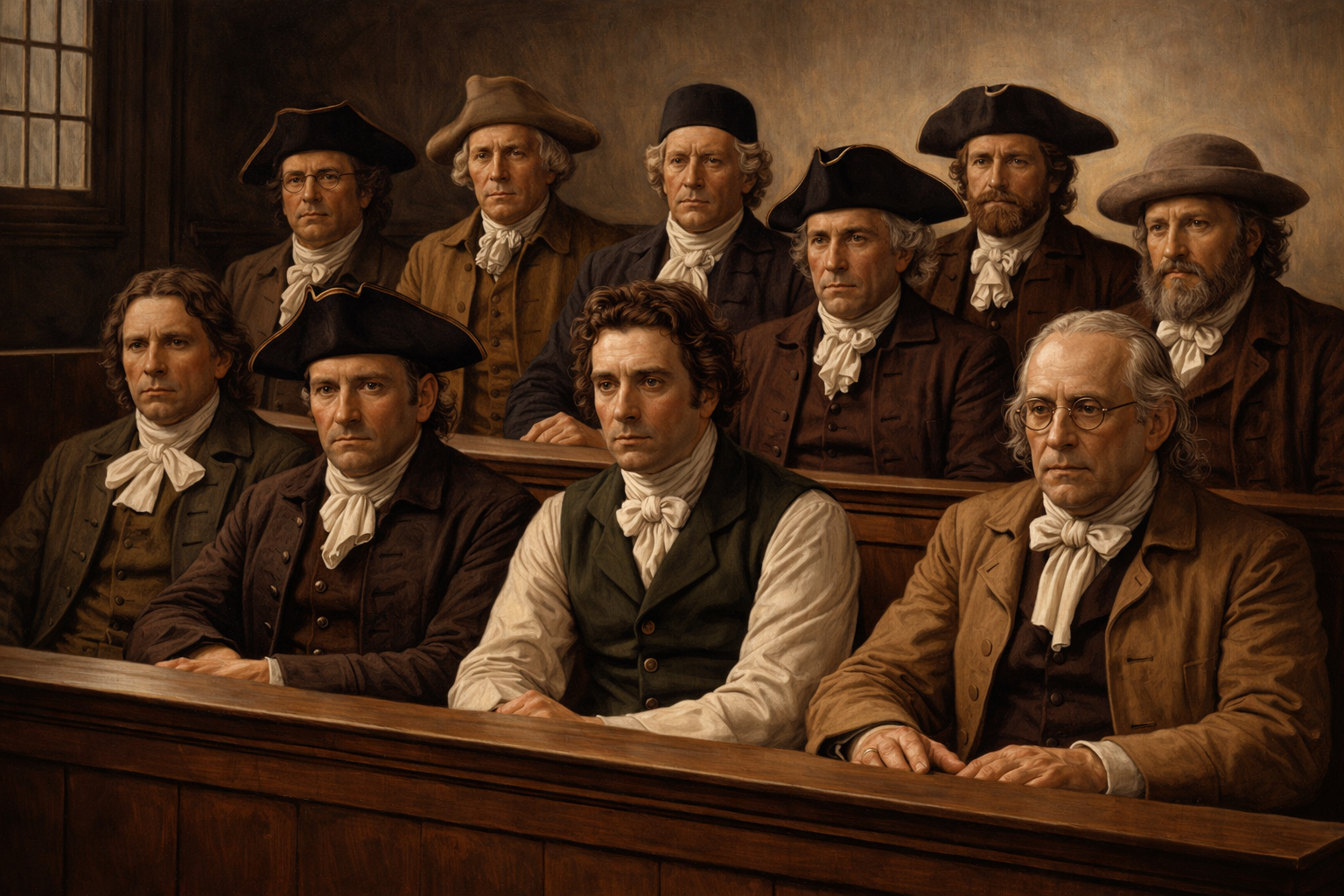
The Fifth Circuit held that presiding over the general assembly of prospective jurors—including qualifying jurors and hearing excuses or exemptions—is a judicial act protected by absolute immunity. (The plaintiffs contended that they had been unfairly treated after appearing for examination as potential jurors.) The Court emphasized that the “touchstone” of the analysis is whether the judge is “resolving disputes between parties” or “authoritatively adjudicating private rights,” and that the act of qualifying a venire and hearing excuses inherently involves the exercise of judicial discretion.A dissent saw the judge’s activity as administrative in nature. No. 23-50850, Aug. 1, 2025

Wilson v. Centene Management addressed the proper standard for determining Article III standing at the class certification stage. The Fifth Circuit held: “The class certification approach evaluates only a named plaintiff’s individual standing. The court’s determination that the named plaintiff demonstrated individual standing concludes the inquiry. Only then should the court ‘address the question whether the named plaintiffs have representative capacity, as defined by Rule 23(a), to assert the rights of others.’”

This approach contrasts with a more searching approach that would compare the injuries of the named plaintiff to those of the putative class and determine whether the named plaintiff’s harms are sufficiently analogous to those suffered by the rest of the class. The Court expressly rejected this approach as it  “prematurely and unnecessarily muddies the waters for the threshold constitutional issue of justiciability.”

The Court cautioned that “where there is ‘substantial overlap between’ standing and the merits of a plaintiff’s claim, ‘the better course’ is to treat the attack on standing ‘as an attack on the merits— and therefore outside the scope of our Rule 23(f) review of class certification decisions—rather than as a question of standing.’” No. 24-50044, July 17, 2025


In Association of Club Executives v. Paxton, a group of plaintiffs associated with the adult entertainment industry (who have had an unfortunate record in the courts in recent years), the Fifth Circuit addressed the constitutionality of a Texas law that raises the minimum employment age at sexually oriented businesses (SOBs) from 18 to 21.

The court upheld the law, finding that it withstands First Amendment scrutiny because it is designed to serve a substantial government interest—namely, the prevention of sex trafficking and sexual exploitation—and does not restrict more speech than necessary. Texas provided sufficient evidence linking SOBs to sex trafficking and that the law was a reasonable measure to address these secondary effects. And, the law does not substantially restrict protected speech, as it leaves SOBs with a “reasonable opportunity to open and operate” their businesses and does not meaningfully limit the expressive conduct of their employees based on age. No. 24-50434, Jul. 14, 2025

The Fifth Circuit granted mandamus relief, in a venue-transfer dispute, requiring a “do-over” by the trial court that fully evaluated all eight relevant factors. In re Media Matters, No. 25-10630 (July 15, 2025). The underlying case is between X (formerly Twitter) and a nonprofit that was critical of how X delivered ads to users.

In Students for Fair Admissions, Inc. v. UT-Austin, the Fifth Circuit addressed whether challenges to both the university’s old and revised admissions policies were moot. The Court held that claims related to the university’s pre-2023 admissions policy, which explicitly considered race, were moot because the policy had been formally repealed and replaced in response to the Supreme Court’s Harvard decision.

However, the Court found that the controversy over the university’s revised, post-2023 admissions policy remained live and was not moot. The new policy, while facially race-neutral, still allowed admissions officers access to applicants’ racial data during the admissions process, which the plaintiff alleged could enable continued discrimination. The court emphasized that “as long as the parties have a concrete interest, however small, in the outcome of the litigation, the case is not moot,” and concluded that the plaintiff had not yet secured all the relief it sought. No. 24-50631, July 11, 2025.

In Reed v. Marshall, the Fifth Circuit addressed whether joint owners of a trademark can sue each other for infringement or dilution under the Lanham Act. The Court held that the Lanham Act does not authorize such claims between co-owners of a trademark.

The Court explained that trademark law is designed to protect owners and consumers from third-party infringers, not to resolve disputes among co-owners Joint ownership of a mark gives each owner a complete interest in the mark, allowing them to use it as they please unless a separate contractual agreement says otherwise. The statutory language of the Lanham Act, according to the court, “makes this cause exclusive to the registrant of the trademark,” and does not contemplate claims by one co-owner against another. No. 24-20198, July 2, 2025

United States v. Texas considers, inter alia, whether an organization that provides legal services to immigrants has standing to challenge a Texas law about illegal entry into the country. The panel majority finds standing; a dissent notes:

“Plaintiffs allege only—just as the doctors did in [FDA v. Alliance for Hippocratic Medicine]—that they want to serve clients who are impacted by the law. That makes the organizations’ standing every bit as impermissible as it was in Alliance.”

No. 24-50149 (July 3, 2025).

Class-action litigation has drawn considerable attention after Trump v. CASA limited the use of nationwide injunctions. Another tool for expanding the impact of a given case is collateral estoppel, and that’s the subject of this article that I recently published in Salon.

In Texas Corn Producers v. U.S. EPA, the EPA disputed the plaintiffs’ standing; among its arguments it “counters that automakers might respond to the inflated CAFE stringency in four different ways—not all of which decrease gasoline demand. Thus, EPA contends, the petitioners’ alleged injury is too speculative to support Article III standing.”

The Fifth Circuit expressed skepticism, noting that this argument was not consistent with the purpose of the challenged regulation in the first instance: “But EPA misses the forest for the trees. Indeed, reducing fuel demand is the core purpose of the CAFE standards. As NHTSA explained in its latest CAFE rulemaking, the current standards are estimated to ‘reduce gasoline consumption by 64 billion gallons relative to reference baseline levels for passenger cars and light trucks … through calendar year 2050.’ If EPA additionally increases CAFE stringency through the backdoor, then gasoline consumption will predictably fall even further.” No. 24-60209 (June 24, 2025) (footnote omitted, emphasis in original).

In Weslease 2018 Operating, LP v. Behan, the Fifth Circuit addressed whether appeals challenging a district court’s turnover and enforcement orders remained live after the court appointed a receiver to take possession of the judgment debtors’ property. The Court held that these appeals were rendered moot by the subsequent receivership order, which “explicitly ‘supersedes and/or amends all portions of the court’s prior orders directing the turnover of assets of any Receivership Parties to Weslease.’”

As a result, the property at issue was no longer in the hands of the original parties but under the exclusive control of the receiver, eliminating any actual controversy that the appellate court could resolve–put another way, the case was now controlled by the principle that mootness arises when “intervening circumstances make it impossible for the court to ‘grant any effectual relief.” No.24-10246, June 5, 2025.

prescient Fifth Circuit panel opinion, perceiving the mismatch between somewhat-dated First Amendment precedent and the realities of modern-day adult entertainment, was affirmed on the last day of the Supreme Court term, albeit by using a different level of scrutiny. Free Speech Coalition, Inc. v. Paxton, No. 23-1122 (U.S. June 27, 2025). Texas’s age-verification laws for access to adult sites will stand; interest in proxy server technology will likely increase substantially.

Last term, the Supreme Court reversed a Fifth Circuit opinion that held the CFPB’s structure violated the Constitution because it was “double insulated” from the annual appropriations process.

The unfortunate track record of “double” arguments continued in this term, when the Supreme Court reversed an en banc Fifth Circuit opinion holding that the FCC’s collection of univeral-service fees amounted to impermissible “double-layered delegation” of Congressional power. The Supreme Court reasoned:

The court’s analogy and associated logic do not work. In Free Enterprise Fund, each of the two layers of for-cause protection limited the same thing—the President’s power to  remove executive officers. And when combined, each compounded the other’s effect, so that the President was left with no real authority. Or otherwise said, the two layers of restrictions operated on a single axis with the one exacerbating (we thought exponentially) the other. But that reasoning has no bearing here. A law violates the traditional (or call it, for comparison’s sake, “public”) nondelegation doctrine when it authorizes an agency to legislate. And a law—whether a statute or, as here, a regulation—violates the private nondelegation doctrine when it allows non-governmental entities to govern. Those doctrines do not operate on the same axis (save if it is defined impossibly broadly). So a measure implicating (but not violating) one does not compound a measure implicating (but not violating) the other, in a way that pushes the combination over a constitutional line. “Two wrong claims do not make one that is right.”

No. 24-354 (U.S. June 27, 2025) (citations omitted).

A toilet became clogged at a Walgreens store, after which an employee gave a customer a plunger to clear the clog. An accident happened later. The Fifth Circuit agreed that the customer was not an agent of Walgreens:

“Gonzalez’s only evidence of an agency relationship is that Perez gave the customer a plunger after Alexander granted Perez permission to do so, and that the customer apparently attempted to unclog the toilet with that plunger. While the customer arguably acted on Walgreens’s behalf, ‘a party is not an agent simply because he acts on behalf of another.’ … [W]hile Walgreens’s permitting the customer to plunge the toilet on its behalf was no doubt imprudent, that does not answer the agency question. ‘Authorization to act and control of the action are the two essential elements of agency.'”

This unusual fact pattern provides an excellent illustration of why proof of agency requires proof of a right to control. Gonzales v. Walgreen Co., No. 24-50403 (June 16, 2025).

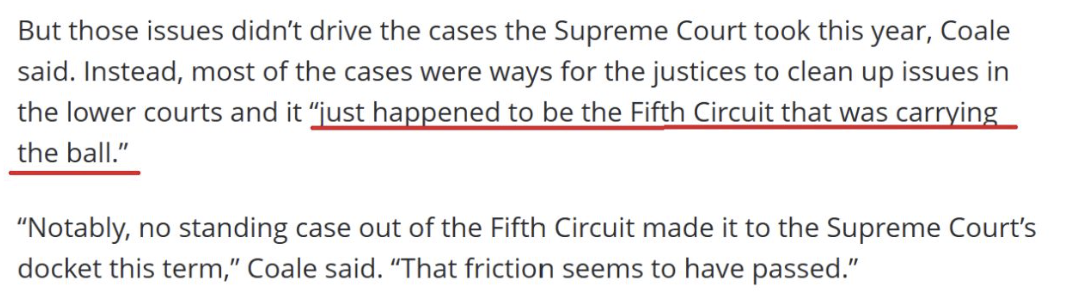
While the long-running friction between the Fifth Circuit and U.S. Supreme Court about standing did not produce cert grants on the topic this term (after last year’s 9-0 reversal on standing in theg mifepristone litigation), three recent Supreme Court reviews of Fifth Circuit opinions involve similar topics, with mixed results:

  1. The Supreme Court held that the Fifth Circuit erred by hearing a challenge to a Nuclear Regulatory Commission decision about a waste facility, when the challenger – the State of Texas – had not been a party to the agency proceeding. NRC v. Texas, No. 23-1300 (U.S. June 18, 2025).
  2. In EPA v. Calumet, the Supreme Court held that the Fifth Circuit erred because challenges to the EPA’s denials of small-refinery exemption petitions under the Clean Air Act belong only in the D.C. Circuit. While each such denial is “only locally or regionally applicable” because it applies to a specific refinery, they fall within the statute’s “nationwide scope or effect” exception when they are “based on a determination of nationwide scope or effect.” No. 23-1229 (U.S. June 18, 2025); cf. Oklahoma v. EPA, No. 23-1067 (U.S. June 18, 2025) (holding that challenges to state-specific emission plans  belonged in a regional circuit, not the D.C. Circuit, because they were “locally or regionally applicable action”).
  3. And in FDA v. R.J. Reynolds, the Supreme Court affirmed the Fifth Circuit’s venue decision about a retailer’s challenge to the FDA’s denial of a permit about a “vaping” product. he FDA argued that only the manufacturer (the applicant) was “adversely affected” and thus eligible to seek judicial review, and that the case should be dismissed or transferred to a different circuit. The Fifth Circuit denied the FDA’s motion and the Supreme Court agreed, olding that retailers who would sell a new tobacco product but for the FDA’s denial are “adversely affected” and may seek judicial review under the TCA. No. 23-1187 (June 20, 2025).

Within the last month, area courts have reached the following holdings:

  • in Ethridge v. Samsung, a Fifth Circuit panel majority found that a manufacturer of batteries was subject to jurisdiction in Texas (over a dissent that shares common ground with the supreme court opinion cited below); No. 23-40094 (5th Cir. May 14, 2025).
  • in BRP-Rotax v. Shaik, the Texas Supreme Court found that a manufacturer of aircraft engines was not subject to jurisdiction in Texas, because it lacked “an intent or purpose to serve the Texas market.” No. 23-0756 (Tex. June 20, 2025); and
  • in Western Trails Charters and Tours, LLC v. Provance, the Dallas Court of Appeals held that an out-of-state bus company purposely availed itself of Texas by entering an “Interline Agreement” with Greyhound, but the “operative facts” of the claims did not arise from those contacts. No. 05-24-01089-CV (Tex. App.–Dallas May 29, 2025) (mem. op.).

All of these opinions are thoughtful and carefully reasoned. But Justice Busby’s concurrence in the Rotax case makes a powerful, big-picture point about this area of law – especially in “stream of commerce” cases, the International Shoe framework is complex, confusing, and remains substantially unsettled after decades of efforts to clarify it. He recommends an “originalist” approach, which may or may not be an improvement in terms of the results reached, but has much to commend it as a long-needed source of certainty in this significant area of commercial law.

Accurately applying the present state of the law, a Fifth Circuit panel in Roake v. Brumley affirmed a preliminary injunction against a Louisiana law requiring display of the Ten Commandments in public-school classrooms. It remains to be seen whether the Supreme Court will change the state of the controlling law. No. 24-30706 (June 20, 2025).

Wheatfall v. HEB reminds, as to actions to confirm arbitration awards, that: “After [the 2022 Supreme Court opinion in Badgerow], Courts may not “look through” a Section 9 and 10 [Federal Arbitration Act] action to establish federal question jurisdiction based on the underlying dispute. Because Wheatfall’s complaint does not raise a federal question on its face, the district court lacked subject matter jurisdiction.”

The opinion drops an intriguing footnote: “Because Wheatfall filed a new action in state court rather than reinstating the original action in federal court, we decline to address the “jurisdictional anchor” theory of continuing jurisdiction,” citing authority from the Fourth and Seventh Circuits – a theory that the court in which an action is filed and arbitration is then ordered continues to have jurisdiction through confirmation. No. 24-20257 (June 18, 2025).


In the Dallas-area state court of appeals, an unfortunate event involving citation to “hallucinated” case authority ended with this sanctions order. Three lessons can be learned:

  1. Avoid using Gen AI to do serious case research. There’s nothing wrong with asking it research questions to get ideas, and that can be quite helpful as part of an overall use of Gen AI to help write — so long as you remember that every citation it returns has to be checked for accuracy. Gen AI programs can look like databases, and they can act like databases, but Gen AI programs are not databases.
  2. If it’s too good to be true, it is. The problem in this case arose from a hallucinated Texas Supreme Court case from the late 19th Century that involved materially similar facts. If that was a Westlaw search result, it would require double-checking because it’s just so unlikely. The best “tell” that Gen AI is hallucinating is that it’s giving you exactly what you want to hear.
  3. Don’t lie behind the log. I don’t know all the facts of this case, but the order says that the appellant’s counsel did not take prompt action when the problem with the hallucinated citations was first brought to light. If something has been cited in error, get out in front of the error before your opponent and the court has to spend needless time and energy helping rectify it.

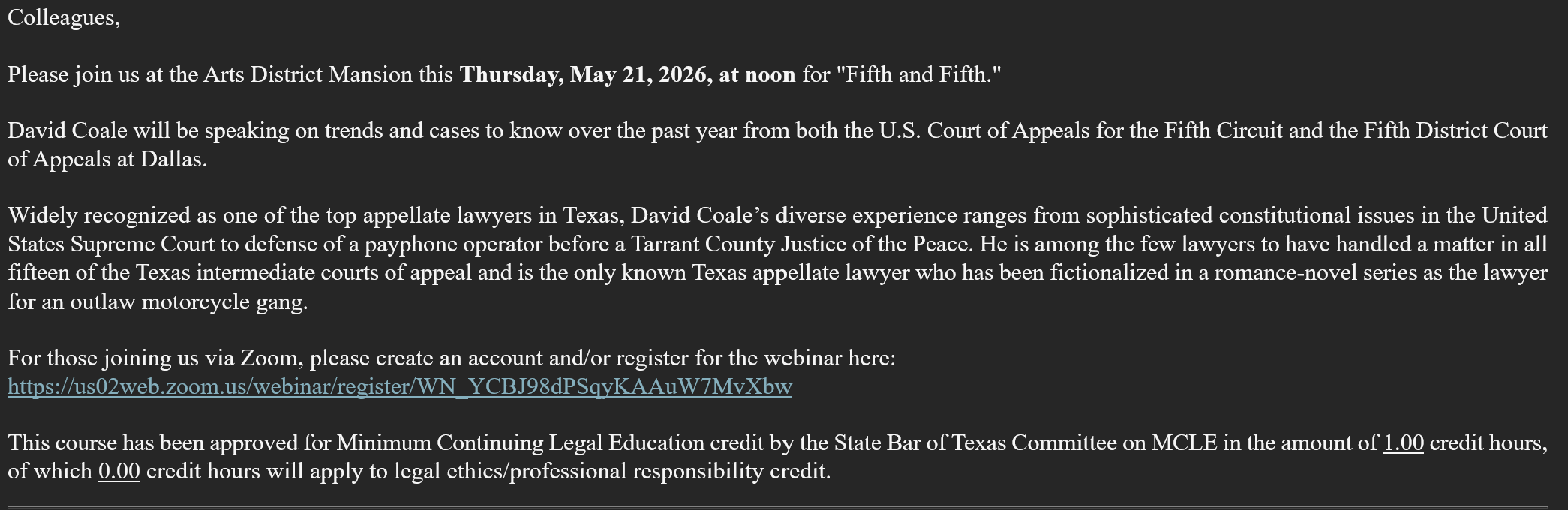
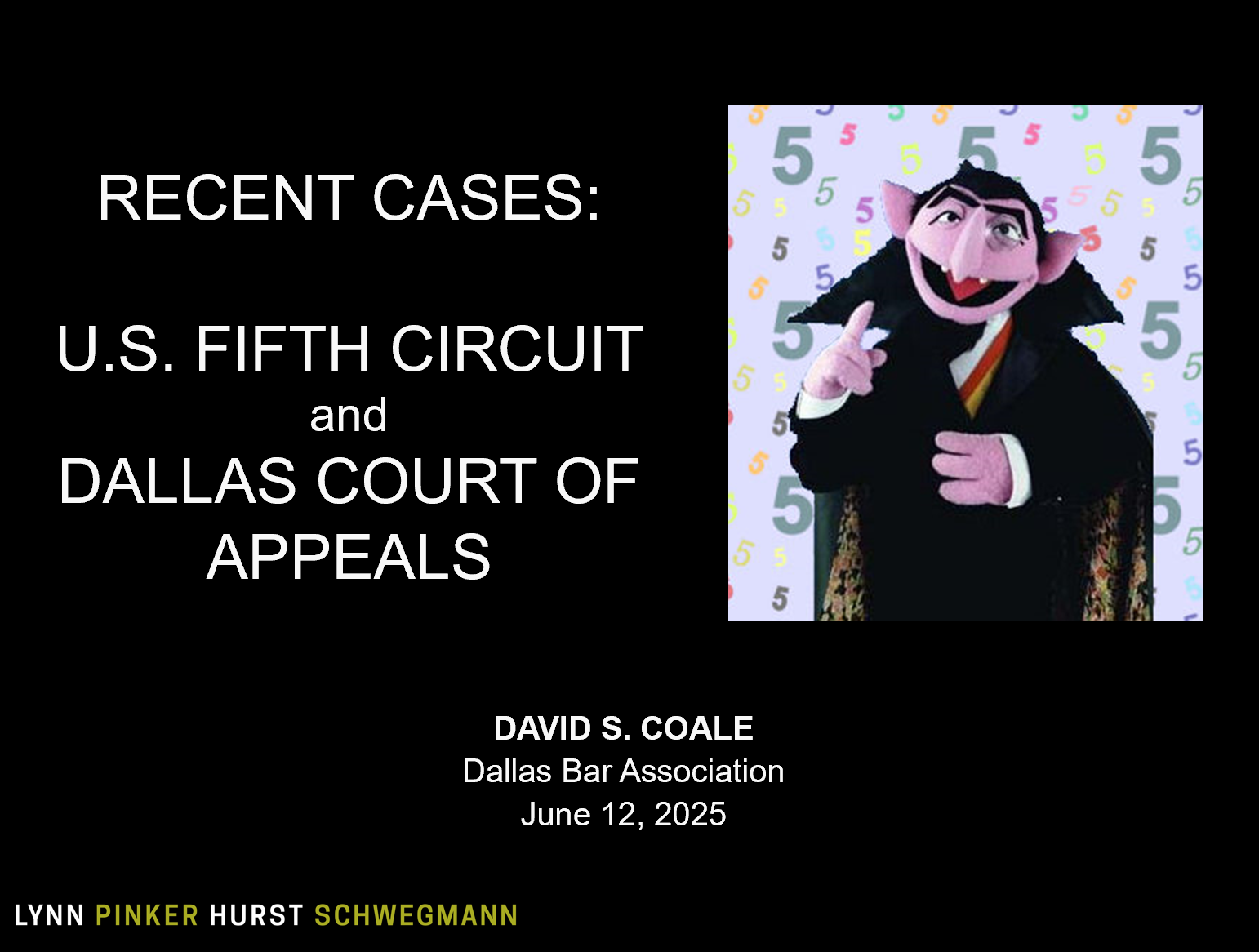
Today I did my yearly “Fifth and Fifth” update, on cases of interest to commercial litigators from the Fifth Circuit and Fifth District. This is a printout of my PowerPoint. In particulary, it was interesting to see how those two court are dealing with the Supreme Court’s recalibration of personal jurisdiction in the 2021 Ford Motor case.

In Morrow v. Jones, the Fifth Circuit addressed whether an appellate court may consider a forfeited issue—specifically, the failure to provide class-wide notice of a motion for attorney fees as required by Fed. R. Civ. P. 23(h). The panel emphasized that it may address a forfeited issue if it “involves a pure question of law, and our refusal to address it would result in a miscarriage of justice.”

Here, the Court held that declining to address the lack of notice would “unjustly deprive class members of the opportunity to object to the fee motion—an opportunity to which they are entitled by statute.” Given the unique context of class actions and the court’s independent obligation to protect class interests, the panel exercised its discretion to reach the forfeited issue, holding that the district court’s failure to provide notice was an abuse of discretion. No. 23-40546, Jun. 10, 2025

In Carter v. Local 556, the Fifth Circuit reversed (among other matters) a contempt order that required a party’s counsel to attend “religious liberty training,” reasoning:

Courts are tasked with resolving limited questions and administering justice to the parties before them. United States v. Texas, 599 U.S. 670, 693–94 (2023) (Gorsuch, J., concurring) (“This tracks the founding-era understanding that courts render a judgment or decree upon the rights of the litigants . . . [and] ensures that federal courts respect the limits of their Article III authority to decide cases and controversies ….” (citations omitted) (cleaned up)). But when a court’s contempt sanction in a civil matter is both overbroad in scope and undoubtedly punitive in nature, the judiciary risks appearing contemptuous like the contemnor. In this civil case, the sanction plainly exceeded remedial bounds and sought to punish Southwest’s attorneys through a directive that did little to coerce the airline’s compliance with the district court’s judgment.

No. 23-10536 (May 8, 2025).

The once-obscure Court of International Trade – once an Article I tribunal, but “promoted” to Article III status in 1956 – took issue with the legal basis for many of the Trump Administration’s tariffs.

Specifically, in V.O.S. Selections, Inc. v. United States, that court held that the International Emergency Economic Powers Act’s authorization for the President to “regulate . . . importation” does not confer unbounded tariff authority: “[T]his court reads ‘regulate . . . importation’ to provide more limited authority so as to avoid constitutional infirmities and maintain the ‘separate and distinct exercise of the different powers of government’ that is ‘essential to the preservation of liberty.'”

The opinion went on to distinguish between the President’s emergency powers and more narrowly tailored statutory authorities, such as those found in the Trade Act of 1974, which specifically limit the President’s ability to impose tariffs in response to trade deficits or other economic concerns. Nos. 25-00066 & 25-00077, May 28, 2025

In Deep South Center of Environmental Justice v. EPA, the Fifth Circuit addressed the requirements for organizational standing and the limits of remote injury, implementing the Supreme Court’s recent decision in FDA v. Alliance for Hippocratic Medicine as follows:

  • An organization cannot establish standing just by diverting resources to oppose a government action or by incurring costs for advocacy in response to that action: “An organizational plaintiff ‘cannot spend its way into standing simply by expending money to gather information and advocate against the defendant’s action.’”
  • Alliance for Hippocratic Medicine requires a “concrete and demonstrable injury to the organization’s activities,” not just a “setback to [its] abstract social interests.” Thus, direct interference with an organization’s core business activities (as in other precedent) is distinct from voluntary changes in programming or advocacy, which are not enough.
  • The panel majority described the petitioners’ claims of future economic, health, property, aesthetic, and recreational injuries as resting on a multi-step chain: a party would have to apply for a permit, the state would have to issue it, a well would have to be constructed and operated, and then some mishap would have to occur that would directly harm the petitioners or their members. And even where some steps had already occurred (such as the filing of permit applications), the other ones—such as the likelihood of a well malfunctioning at a time and place and injuring a specific member—remained speculative.

A dissent concurred in the judgment but questioned the extent of the majority’s holdings about the impact of Alliance for Hippocratic Medicine. No. 24-60084, May 21, 2025.

In Little v. Llano County, , the en banc Fifth Circuit held that decisions by public libraries, about what books to include or remove from their collections, are government speech that is not subject to a First Amendment challenge. (Here is a list of the books at issue, with links to where they can be purchased.)

The majority reasoned that while the First Amendment protects individuals’ rights to receive information from other private parties, it does not create a right to demand that the government provide access to specific information or books through its libraries.

A dissent argued that the First Amendment protects the public’s right to access information and ideas in public libraries, and warned about government officials removing books from libraries because of dislike for their content: ”By eliminating the public’s right to challenge government censorship of public library books, our court’s holding becomes a Trojan horse for the government speech doctrine that fails to command a majority in its own name.” No. 23-50224 (May 23, 2025).

Speech First, Inc. v. McCall involved a First Amendment challenge to a dodgy “haratssment policy” at Texas State University, which the university argued had become moot. The Court held that the lawsuit was not moot, applying the Circuit’s three-factor test for this situation.

First, the university had not issued a binding statement of future intent not to reinstate the challenged policy, and there was “no evidence” that the university’s assurances would control future actions “during or after the tenure of the University’s present leadership.”

Second, the timing of the policy change was suspicious, as the university amended its policy only after the lawsuit was filed and in direct response to judicial pressure, rather than as a voluntary act.

Third, the university continued to defend the legality of its original policy throughout the litigation, further undermining any claim that the challenged conduct would not recur.

The court emphasized that “mere voluntary cessation of allegedly illegal conduct does not moot a case; if it did, the courts would be compelled to leave the defendant free to return to his old ways.” No. 23-50633, May 14, 2025.

The en banc Fifth Circuit overruled an obsolete precedent about removal, as follows:

In this case, a Texas law firm sued one of its former attorneys, Edward Festeryga, in state court, alleging that he took firm files and clients to his new practice. Seventeen days later—well within the 30-day statutory removal window—Festeryga removed the case to federal court. The district court, however, remanded the case, concluding that
Festeryga had waived his removal right by filing a motion to dismiss in state court. Bound by [In re Weaver]—and acknowledging its “erroneous premises”—a panel of this court “reluctantly” dismissed Festeryga’s appeal for lack of appellate jurisdiction. … Today, we do what only this court sitting en banc can: we correct course and “unweave Weaver.”

Abraham Watkins v. Festeryga, No. 23-20337 (May 16, 2025).

Ethridge v. Samsung presents, yet again, a close case about personal jurisdiction over an out-of-state manufacturer. The claim arose from an exploding lithium-battery; two sets of contacts were relevant:

  1. “Since January 2019, Samsung has shipped 18650 batteries to Black & Decker’s Texas manufacturing facility to be incorporated into sealed power tool battery packs. For a number of years (at all times relevant to this litigation), Samsung has also shipped 18650 batteries to HP and Dell to be used as samples or for laptop repairs in their Texas service centers.”
  2. “Samsung sells 18650 batteries to ‘sophisticated and qualified’ businesses, which typically use them in battery packs. Some of these battery packs end up in products that are sold to Texas consumers. Samsung contends, however, that it has no control over what happens to its 18650 batteries after it sells them to its business customers in Texas.”

The panel majority concluded that Texas jurisdiction was appropriate in light of the Supreme Court’s most recent treatment of a similar issue in its 2021 Ford Motor opinion. A dissent saw matters differently:

The unilateral choices of an individual-consumer plaintiff have not been determinative of specific jurisdiction in modern history. Instead, an unbroken string of Supreme Court cases, with a recent, narrow exception in Ford, focus on the purposeful actions of the defendant in a forum state. Here, the defendant’s forum-state activities are wholly unrelated to the plaintiff’s purchase and use of the relevant product. Therefore, because Ethridge purchased the battery for his vape pen through a channel that Samsung never authorized, the fact of his injury should not make Texas a valid forum consistent with Due Process.

No. 23-40094 (May 14, 2025). 

I recently moderated a panel at the Fifth Circuit Judicial Conference about AI and the law, and was honored to meet two energetic thinkers in that important and rapidly developing area. You can learn more about them here:

  • Judge Scott Schlegel, a Louisiana appellate, who publishes a lively and thoughtful blog about AI issues. I highly recommend keeping an eye on it.
  • Professor Yonathan Arbel, of the University of Alabama Law School, who recently published a thought-provoking article in the NYU Law Review about how judges can productively use large language models when interpreting contracts.

I hope you enjoy their work and follow their thought leadership on the world-changing force of generative AI technology.

A breach-of-contract suit against a governmental entity led to these holdings about how the district court handled immunity defenses:

The district court thus made two errors. First, the district court held that Texas’s state-law immunity from suit deprived it of subject matter jurisdiction. But state-created immunities do not and cannot limit the jurisdiction of federal courts. If these state-law immunities apply at all in federal court under the Erie doctrine, they must be treated as non-jurisdictional, merits-based defenses. 

The second error flows directly from the first. The district court dismissed for lack of jurisdiction—without addressing the two other bases for dismissal that really do implicate subject matter jurisdiction. State sovereign immunity and the absence of complete diversity—unlike state-law immunities—are jurisdictional defects. And either of the former two problems would require a without-prejudice jurisdictional dismissal. Such jurisdictional problems must be addressed first, before the district court considers any merits-based defenses.

Anthology, Inc. v. Tarrant County College Dist., No. 24-10630-CV (May 2, 2025).

“Grafting ‘manifest disregard of the law’ as a basis for a losing party at arbitration to prevail under § 10(a)(4) would risk tension with Hall Street—and would run headlong into Oxford Health—by forcing us to conduct a less deferential review of a panel’s award than the FAA contemplates. Indeed, adopting [Appellant’s] reading essentially would rewrite the question a judge must ask from ‘whether the arbitrators construed the contract at all’ to ‘whether they construed it correctly.'” No. 24-10833 (Apr. 28, 2025).

Providing a counterpoint to another recent case about contractual conditions, in UniWell Labs v. Frain Indus., the Fifth Circuit an invoice that detailed payment terms and said that “[l]ead time is 10 weeks from receipt of deposit payment, signed lease agreement[,] and testing materials ….”

Despite UniWell making the required payments, it never signed the lease agreement, even after multiple requests from Frain. Accordingly, “UniWell’s entire breach-of-contract claim against Frain, predicated on the lease agreement, fails because UniWell did not sign any lease agreement. There was thus no enforceable lease agreement between the parties.” No. 24-10204 (Apr. 14, 2025).

In SpaceX v. NLRB, the Fifth Circuit held that the district court did not “effectively deny” SpaceX’s motion for a preliminary injunction (so interlocutory appeal under 28 U.S.C. § 1292(a)(1) was not allowed). The Court noted:

  • SpaceX’s alleged harm—having to participate in an administrative teleconference—was not a “serious, perhaps irreparable, consequence,” and cited precedent that “defending charges brought by an agency does not constitute a ‘serious, perhaps irreparable, consequence’”—especially when SpaceX had previously participated in two similar teleconferences.
  • SpaceX did not request expedited briefing until April 26, asking for a ruling “no later than May 2, 2024,” despite the motion being fully briefed since February 12, and then noticed its appeal just two days before its self-imposed deadline.
  • SpaceX chose to make repeated challenges to a transfer order and requested its reconsideration, which also affected the timing of the injunction proceeding.

No. 24-40315, Mar. 5, 2025

The Fifth Circuit found no abuse of discretion about the appointment of a receiver in SEC v. Barton, emphasizing these aspects of the controlling three-factor test:

  • Receivership was “clear[ly] necess[ary] to protect a party’s interest in property” because:
    • The investors’ property interests faced threats from the defendant’s continued dissipation of assets, market conditions, and third-party actions (such as liens, lawsuits, and foreclosures).
    • The defendant continued to spend investor funds even after the SEC filed its complaint, showing no deterrence from prior legal action.
    • The receivership allowed for active management of assets, which included operating businesses and properties requiring ongoing oversight.
    • The receivership enabled the court to stay litigation and foreclosure actions, preventing further loss of value to the receivership estate.
  • Less drastic remedies, such as a monitorship or asset freeze, were inadequate because:
    • These alternatives would still allow the defendant some control over the assets, increasing the risk of further dissipation.
    • The district court had already found the defendant in contempt for violating prior requirements, indicating that a monitorship would not be effective.
    • The assets required dynamic management, which a freeze or monitorship could not provide.

Nos. 23-11237 & 24-10004 (April 17, 2025).

The issue in Equistar Chemicals, LP v. Indeck Power Equip. Co. was whether the below contract provision, coupled with another provision requiring that all notices be in writing, created a condition precedent of notice to a damages claim under a contract:

The Fifth Circuit held that no condition precedent was created:

[T]here is no conditional language connecting that notice requirement to Equistar’s ability to seek a contractual remedy. Article 8(b) does not use the words “if,” “provided that,” “on the condition that,” “prior to,” or any other similar phrase to create a condition. It also does not limit Equistar’s ability to exercise its contractual remedies. In other words, there is no link between a condition precedent (notice) and a conditioned obligation (suing for breach of warranty or contract).

No. 21-20345 (April 23, 2025).

In the unlikely-named case of 8fig, Inc. v. Stepup Funny, LLC, the Fifth Circuit reaffirmed the presumption in favor of public access to judicial records, emphasizing that “sealing judicial records is … heavily disfavored.” While courts may seal records on a case-by-case, document-by-document, line-by-line basis, the burden rests on the party seeking to keep records sealed to demonstrate specific interests that outweigh the public’s right to access. Here, the parties’ general assertions of privacy and confidentiality, as well as the existence of a settlement agreement, were insufficient to overcome the presumption of openness.

The Court noted that even if confidentiality was a factor in reaching settlement, this would only weigh in favor of sealing the settlement terms themselves, not the entire judicial record. Importantly, the Court reminded that “record may not be sealed ‘merely because it could lead to a litigant’s embarrassment.'” No. 23-50890 (Apr. 18, 2025).

In Allied World Nat’l Assurance Co. v. Nisus Corp., the Fifth Circuit addressed a  limitations issue in a products-liability dispute involving damage to fire-protection sprinkler systems. The court held that the claims were time-barred under Louisiana law, which, at the relevant time, imposed a one-year prescriptive period for products-liability actions, and considered “constructive knowledge” to trigger the running of prescription.

Here, the agent responsible for property maintenance had constructive knowledge of the cause of the damage well before the one-year period preceding the filing of the lawsuit, and that knowledge was imputed to the principal. The Court rejected arguments that the agent’s inaction or the defendant’s alleged misrepresentations tolled the prescriptive period, finding that a reasonable investigation would have uncovered the relevant information in time. No. 24-30386, Apr. 18, 2025.

After affirmance of the Fifth Circuit in SEC v. Jarkesy, that Court returned to the interaction between the Seventh Amendment and the admininistrative state in AT&T Inc. v. FCC. The specific issue was whether the FCC’s  in-house enforcement procedures for imposing civil penalties violate the constitutional right to a jury trial, as clarified by Jarkesy.

The court held that the FCC’s process ran afoul of the Seventh Amendment, emphasizing that these civil penalties are “the prototypical common law remedy,” designed to punish or deter, and thus “a type of remedy at common law that could only be enforced in courts of law.” In particular, and FCC enforcement action under section 222 of the Telecommunications Act resembles a negligence action, as it centers on whether the carrier took “reasonable measures” to protect customer data, notwithstanding the technical nature of the factual situation.

The Court also rejected the FCC’s argument that the availability of a later trial in federal court—after the agency has already found liability and imposed penalties—satisfies the Seventh Amendment. In such a trial, explained the Court, the defendant cannot challenge the legal conclusions of the agency, only the factual basis, and that this structure forces companies to choose between a jury trial and the ability to challenge the legality of the order. No. 24-60223, Apr. 17, 2025. (A third judge concurred without opinion).

In the case of Wilson v. Kemper Corp. Servcs., the Fifth Circuit held that the district court erred in denying the plaintiff’s motion to remand, because the non-diverse defendant was properly joined.

The Court emphasized that under Mississippi law, the “duty to read” doctrine did not bar the plaintiff’s negligence claim against that defedndant. The Court further explained that the district court’s reliance on Maria Wilson’s affidavit, which admitted her illiteracy and inability to read the policy, was insufficient by itself to establish improper joinder, especially when the policy’s language was ambiguous and did not explicitly require the plainitff to reside in the house to be covered. No. 24-60090, Apr. 11, 2025.

State of Mississippi v. JXN Water addressed whether an order compelling the disclosure of SNAP recipient data qualifies as an appealable collateral order.

Remininding that the requirements for a collateral order are “stingent,” the Fifth Circuit found them satisfied here. The order (1) conclusively determined a disputed question, (2) resolved an important issue separate from the merits of the case, and (3) was functionally unreviewable on appeal from a final judgment. On the last point, the Court emphasized that once the confidential information of SNAP recipients is released, “no relief can make the information confidential again.” No. 24-60309, Apr. 10, 2025

Zyla Life Sciences v. Wells Pharma of Houston arose when a maker of compounded suppositories accused a competitor of butting into its business. The defense argued that the plaintiff’s state-law claim was preempted. The Fifth Circuit disagreed:

The question presented is whether a State triggers implied obstacles-and-purposes preemption when it expressly incorporates federal law into state law. The district court held yes. But as the Supreme Court held almost a century ago, “there is no conflict in terms, and no possibility of such conflict, for the state statute makes federal law its own.”

No. 23-20533, Apr. 10, 2025 (citation omitted).

The hapless plaintiff in Villarreal v. City of Laredo continues to be out of court. After winning in the Supreme Court on the viability of her First Amendment retaliation claim, the Fifth Circuit affirmed dismissal based on qualified immunity.

The majority opinion emphasized that the events in question occurred in 2017, predating a 2019 Supreme Court decision on the topic; as of 2017, the Supreme Court’s precedent held that there was no clearly established right to be free from a retaliatory arrest supported by probable cause.

A concurrence questioned whether qualified immunity should apply when the constitutional right is clear but the remedy is not, suggesting that the rationale for qualified immunity may not hold in cases where officials have ample time to make decisions, as opposed to split-second judgments.

A dissent argued that in light of the Supreme Court’s opinion, remand to the trial court for consideration in the first instance of qualified immunity was appropriate. No. 20-40359, Apr. 8, 2025.

The Supreme Court’s recent ruling in Trump v. JGG, in addition to clarifying what legal relief is available against use of the Alien Enemies Act, confirmed that venue for those challenges will likely be within the Fifth Circuit: “For ‘core habeas petitions,’ ‘jurisdiction lies in only one district: the district of confinement.’ The detainees are confined in Texas, so venue is improper in the District of Columbia.” 

In DeWolff, Boberg & Associates v. Pethick, the the Fifth Circuit held that the plaintiff’s evidence was insufficient to establish a genuine dispute of material fact about tortious interference. The record cited was an email from an employee requesting a copy of a confidential list before leaving for a competitor, along with “the allegedly suspicious timeline of the prospective clients hiring the [competitor] after [the employee] left DB&A .” This was not enough to prove that he actually possessed or used the list to interfere with DB&A’s business. No. 24-10375, Apr. 3, 2025.

The question whether an administrative agency has unfairly “changed the rules” is central in many challenges to regulations. On April 2, the Supreme Court addressed a particularly hard-fought dispute about that issue in FDA v. Wages & White Lion Investments, LLC, a case about the FDA’s denial of marketing authorization for flavored e-cigarette products.

The en banc Fifth Circuit held that the FDA acted arbitrarily and capriciously by applying different standards than those stated in its predecisional guidance documents, and by failing to review marketing plans previously deemed critical.

The Supreme Court held that the FDA’s denial orders were consistent with its predecisional guidance about scientific evidence, comparative efficacy, and device type. The Court concluded that the FDA’s guidance documents did not commit to any specific type of study, and that the FDA’s requirement for manufacturers to compare their flavored products to tobacco-flavored products was a natural consequence of its guidance. No. 23-1038 (U.S. Apr. 2, 2025).

In United States ex rel. Montcrief v. Peripheral Vascular Assocs., P.A.., the Fifth Circuit addressed two sets of claims under the False Claims Act: the “Testing Only” claims and the “Double Billing” claims.

The court affirmed the district court’s grant of partial summary judgment on the Testing Only claims, finding them actionable because the claims were factually false. Specifically, the Court noted that Peripheral Vascular Associates (PVA) billed Medicare for vascular ultrasounds using “global” CPT–4 codes, before the professional component of the ultrasounds was completed.  This meant that the services billed were not fully rendered at the time of billing, making the related claims “factually false.”

In contrast, the Court reversed summary judgment on the Double Billing, which involved patients who received visits for other purposes as well as vascular ultrasounds, with the interpretive reports for the ultrasounds sometimes finalized after billing.  The Court concluded that the CPT–4 Manual was ambiguous regarding whether separate reports were required in this situation. No. 24-50176, Mar. 28, 2025.

Venue disputes—specifically, between courts in Washington DC and those in the Fifth Circuit—are again on the horizon as a result of challenges to aggressive use of immigration-related laws by the Trump Administration.

In yesterday’s case of J.G.G. v. Trump, the D.C. Circuit denied an emergency motion to stay TROs against the use of the Alien Enemies Act to detain and remove Venezuelan citizens. No. 25-5067 (D.C. Cir. March 26, 2026). While the operative judgment of the panel comprises only a one-page order, each of the three judges wrote an opinion (two concurrences and one dissent), as follows:

  • Judge Karen Henderson noted that the Act grants the President near-blanket authority to detain and deport noncitizens affiliated with a belligerent state during times of war or invasion.  However, she underscored the necessity of judicial oversight, stating, “The Alien Enemies Act sets forth ‘conditions upon which it might be invoked’ but is silent as to ‘how long the power should last when properly invoked.'”
  • Judge Patricia Millett argued that the government’s position, which would allow for the summary removal of individuals without any opportunity for judicial review, was fundamentally at odds with the Constitution’s guarantee of due process.
  • Judge Justin Walker’s dissent contended that the plaintiffs’ claims should have been brought in the Southern District of Texas, where they were detained, rather than in the District of Columbia.  He also argued that the district court’s orders interfered with sensitive national security operations.

The Supreme Court today reversed the Fifth Circuit’s invalidation of an ATF regulation about “ghost guns,” noting that the relevant statute applied to “any weapon (including a starter gun) which will or is designed to or may readily be converted to expel a projectile by the action of an explosive.”

That grant of authority is readily distinguished from last Term’s opinion in Cargill v. Garland, which involved a statute focused on a specific type of firing mechanism.

In JSW Steel (USA) Inc. v. Nucor Corp., the Fifth Circuit affirmed the dismissal of JSW Steel’s antitrust claims against Nucor, U.S. Steel, and AK Steel.

The Court held that JSW failed to plausibly allege a conspiracy in violation of the Sherman Act.  The allegations of parallel conduct by the defendants, such as their simultaneous objections to JSW’s tariff exclusion requests and their similar creditworthiness requirements, did not sufficiently suggest a preceding agreement.  The Court emphasized that “parallel conduct that could just as well be independent action” does not meet the threshold for establishing a conspiracy under the Sherman Act.

Additionally, the Court found that much of the conduct alleged by JSW was protected under the Noerr-Pennington doctrine, which shields parties from antitrust liability when petitioning the government for favorable action.  That activity included the defendants’ certifications to the Bureau of Industry and Security (BIS) and their coordination in discussing changes to the steel Section 232 exclusion process. No. 22-20149, Mar. 17, 2025

In a famous dissent from a death-penalty case, Justice Harry Blackmun wrote: “From this day forward, I no longer shall tinker with the machinery of death ….”

Others have continued such tinkering, however, leading to the macabre question presented in Hoffman v. Westcott — whether the Eighth Amendment forbids execution by “nitrogen hypoxia” sa opposed to a firing squad.

The panel majority held that this question was for the state to resolve; the dissent, for the district judge based on the preliminary-injunction record. No. 25-70006-CV (March 14, 2025).

The en banc Fifth Circuit recently denied review of Repub. Nat’l Comm. v. Wetzel – a panel opinon in a larger tradition of conservative distaste for mail. A dissent by Judge Higginson favorably noted commentary on the panel opinion, which draws an interesting distinction among (1) the parties’ briefs; (2) amicus submissions; and (3) public commentary, whether by academics or practioners (or earnest bloggers):

We benefit from lawyer insight and criticism. Though we receive amicus curiae briefs less frequently than the Supreme Court, they provide primary opportunity for non-party lawyers to give insight, albeit with stringent requirements. It is rarer that topflight lawyers, like Unikowsky, have time to offer scholarly critique of a case neither he, nor Bernstein, was retained to handle. Chief Justice Roberts recently reminded that “public engagement with the work of the courts results in a better-informed polity and a more robust democracy.” It is for this reason that the judiciary depends on lawyers, not just as party advocates, but also for all forms of engagement with courts. “[I]nformed criticism” of court opinions from lawyers unaffiliated with the parties is in that vital tradition.

I explored the interplay between non-litigation sources of information and the party-presentation principle in this Cornell Law Review article last year.

In Golden Bear Ins. Co. v. 34th S&S, LLC, the Fifth Circuit rejected an insurer’s declaratory-judgment action about coverage.

The Court emphasized that the Declaratory Judgment Act is intended to provide “early adjudication” of legal rights before disputes ripen into violations of law or breaches of contractual duty. In this case, the alleged misconduct by Golden Bear—negligently refusing to settle a claim—had already occurred, as evidenced by the jury’s verdict exceeding the policy limit.

Therefore, Golden Bear’s could not seek a declaratory judgment  to argue retroactively that it never had a duty to settle was inappropriate. More broadly, the Court observed:  “Allowing the complaint to proceed here would ‘enable a prospective negligence action defendant to obtain a declaration of non-liability,’ which ‘is not one of the purposes of the declaratory judgment act[].'” No. 24-20332, Mar. 14, 2025.

Despite an instruction not to consider interest in determining damages, and “[a]lthough jurors are presumed to follow jury instructions, that presumption does not prevent the court from observing and acting on an obvious failure to have done so.” Therefore, in Ramsey v. Sheet Pile LLC, when it was apparent that “the jury awarded damages on the loan based on the amount owed as of the date of the verdict, not as of the date [Plaintiff] filed suit,” the proper course was to have the district court offer an appropriate remittitur to restore order to the verdict while also carrying out its obligation to calculate post-judgment interest as an issue of law. No. 23-50911 (March 3, 2025).

Ramsey v. Sheet Pile LLC presents an interesting issue about the “prior material breach” doctrine under Texas law. In that case, the issue went nowhere because it had not been raised below and did not rise to the level of plain error. The specific question, though, is the extent to which “there is a bright-line legal rule that suing under a contract prohibits a plaintiff from relying on a defendant’s prior material breach to excuse his own breach” – a question that can become complicated if a contract dispute involves both monetary issues and nondisclosure-type obligations. No. 23-50911 (March 3, 2025).

Fans of the “Emergency!” TV show will recall Rampart General Hospital (right). In Rampart Resources v. Rampart/Wurth Holding, the Fifth Circuit evaluated the likelihood of confusion between two businesses that both used the name “Rampart”:

  1. Type of Mark. The strength of Rampart Resources’ arbitrary trademark was balanced by widespread third-part y usage of the key portion of the mark. This digit weighed in favor of Rampart Resources, but not heavily.
  2. Similarity Between the Marks. The similarity between the marks was not substantial. The only common element was the word “Rampart,” and the overall appearance, sound, and meaning of the marks were different. This digit weighed in favor of Rampart/Wurth.
  3. Similarity of the Services. There was only a minor overlap in the services provided by the parties—both operated broadly in the real estate industry, but their specific services did not substantially overlap. This digit weighed somewhat in favor of Rampart Resources.
  4. Identity of the Retail Outlets and Purchasers. The court found that the retail outlets and purchasers were not sufficiently similar to cause confusion. This digit weighed in favor of Rampart/Wurth.
  5. Identity of the Advertising Media Used. Both parties used word-of-mouth and online advertising but the evidence was insufficient to make this digit probative, either way.
  6. Defendant’s Intent. The court found no evidence of bad intent on the part of Rampart/Wurth.  This digit was neutral.
  7. Actual Confusion. The court acknowledged some evidence of actual confusion, such as misdirected phone calls and a FedEx driver’s confusion. However, it found that this evidence was not particularly weighty and did not show that any confusion swayed consumer purchases.  This digit weighed slightly in favor of Rampart Resources.
  8. Degree of Care Exercised by Potential Purchasers. The court found that the sophistication of the clients and the care they exercised in making purchasing decisions weighed against a likelihood of confusion. This digit weighed in favor of Rampart/Wurth.

Overall, the Court affirmed the district court’s decision to deny a preliminary injunction. No. 24-30111 (Feb. 24, 2025).

At a recent BAFFC CLE program at the Texas A&M Law School in Fort Worth, the Fifth Circuit’s able clerk Lyle Cayce presented the most recent version of his office’s “Appeal Flowchart.” It’s a top-notch reference about that Court, and a good general guide to the workinsg of all appellate courts.

In State of Texas v. Trump, the Fifth Circuit considered whether an executive order by President Biden, mandating a $15 minimum wage for federal contractors, fell within his authority under the Federal Property and Administrative Services Act (FPASA). That statute lets the President “prescribe policies and directives that the President considers necessary to carry out this subtitle,” provided that these policies are consistent with the Act’s objectives. The court found that the Executive Order’s purpose of promoting “economy and efficiency in procurement by contracting with sources that adequately compensate their workers” aligns with the FPASA’s goals, and that the minimum-wage requirement was within the scope of his discretion. No. 23-40671 (Feb. 4, 2025).

Continuing a theme seen in an earlier DOGE-related ruling, a district judge in Washington DC denied a TRO in a data-access case, observing: “The court is aware that DOGE’s unpredictable actions have resulted in considerable uncertainty and confusion for Plaintiffs and many of their agencies and residents. But the ‘possibility’ that Defendants may take actions that irreparably harm Plaintiffs ‘is not enough.'” (emphasis in original, citations omitted).


The plaintiff in Pie Development v. Pie Carrier Holdings, Inc. tried to have its pie and eat it too, encountering a res judicata bar as a result of previous litigation. Specifically, in the earlier case, the plaintiff was given leave to replead and instead elected to appeal, after which the Fifth Circuit affirmed. In this, second, case, the Court held:

After the district court dismissed the Pie I claims without prejudice, Pie Development declined the opportunity to amend its complaint in the district court and chose instead to appeal. Although we have not directly addressed the application of res judicata in these unique circumstances, our caselaw suggests that there is a final judgment on the merits in such a case. When a prior action is dismissed without prejudice and the plaintiff, declining the opportunity to amend the complaint, appeals, the dismissal without prejudice converts to a dismissal with prejudice and constitutes a final judgment on the merits for res judicata purposes.

No. 24-60155 (Feb. 3, 2025).

I make a provocative point in Salon today, suggesting that a litigant unwilling to respect judicial mandates should not expect a warm welcome from the courts.

In National Automobile Dealers Assoc. v. FTC, the Fifth Circuit vacated the FTC’s “Combating Auto Retail Scams Trade Regulation Rule” (CARS Rule) because the FTC failed to to issue an advance notice of proposed rulemaking (ANPRM) as required by its own regulations.

The court rejected the FTC’s argument that the Dodd-Frank Act exempted it from the ANPRM requirement.  While the Dodd-Frank Act allows the FTC to use regular APA procedures for rulemaking concerning auto dealers, it does not eliminate the FTC’s internal procedural safeguards. A dissent argued that the petitioners failed to show prejudice from the lack of an ANPRM, given their extensive participation in the rulemaking process. No. 24-60013, Jan. 27, 2025


Airlines for America v. DOT addressed when additional rulemaking notice is called for because of new factual information. The Fifth Circuit concluded that the Department of Transportation (DOT) had relied on new data from a study study, to justify its rule on airline fee disclosures without providing an opportunity for public comment on this data.

This omission was material because the study supplied basic assumptions used by the DOT to estimate the net benefits of the rule, which ranged from $30 million to $254 million annually. The Court stated that the DOT’s reliance on this new data without public input constituted a “serious procedural error.” Nos. No. 24-60231 and 24-60373 (Jan. 28, 2025).

The Fifth Circuit returned to the question of standing in Airlines for America v. DOT, as to the standing of Texas to challenge the DACA program. The Court reaffirmed that Texas has standing based on a “pocketbook-injury theory,” which asserts that the presence of DACA recipients imposes significant financial burdens on the state.

Specifically, Texas argued that it incurs over $750 million annually in costs related to emergency healthcare and public education for DACA recipients. The Court stated:  “Texas has made this showing by putting forward sufficient, unrebutted evidence to support the ‘common-sense assertion’ that, absent DACA, some recipients would leave the United States.”

The Supreme Court and the Fifth Circuit have not seen eye-to-eye in a number of recent cases that present questions of standing. In this case, however, the Court concluded that these recent cases did not unequivocally overrule the Fifth Circuit’s prior holding in an earlier appeal that concluded Texas had standing to challenge DACA. No. 23-40653, Jan. 17, 2025.

Texas Bankers Association v. CFPB presents a sign of the times, with the change of Presidential administrations: “A new President was inaugurated January 20, 2025. This case had already been set to be orally argued on February 3, 2025. The morning of oral argument, CFPB notified the court that “[c]ounsel for the CFPB has been instructed” by new leadership “not to make any appearances in litigation except to seek a pause in proceedings.” Accordingly, although both sides appeared in court as scheduled, only Texas Bankers addressed the merits.” No. 24-40705 (Feb. 7, 2025). A temporary stay was then ordered to allow the CFPB to finalize its decisionmaking about the case.

Cook v. Marshall addressed the issue of citizenship of a trust for jurisdictional purposes. The Fifth Circuit noted that “traditional trusts . . . were not considered distinct legal entities at common law, and hence cannot sue or be sued in their own name.”  Under that rule, only the citizenship of the trustee parties matters for diversity purposes.  Applied here, that rule means that complete diversity existed because the trustee parties, Cook and Marshall, were citizens of different states—Louisiana and Texas, respectively. The Court referenced the Seventh Circuit’s approach in the 2018 case of Doermer v. Oxford Fin. Group, which held that “when a trustee of a traditional trust ‘files a lawsuit or is sued in her own name, her citizenship is all that matters for diversity purposes.'” No. 24-30222, Jan. 23, 2025

In McDonnell Grouo, LLC v. Starr Surplus Lines Ins. Co., the Fifth Circuit addressed the perennial topic of contract ambiguity; in this case, in the context of a builder’s risk insurance policy. The court affirmed the district court ‘s conclusion that the flood deductible provision in the policy was ambiguous.

The ambiguity arose from the language: “5% of the total insured values at risk at the time and place of loss subject to a $500,000 minimum deduction as respects … FLOOD.” The plaintiffs and the insurers had reasonable interpretations of this provision, but extrinsic evidence, in the form of industry standards and expert testimony, resolved the ambiguity. That extrinsic evidence clarified the term “VARTOL” (value-at-risk-at-time-of-loss) to mean the total value of the project at the time of loss, favoring the insurers’ interpretation. No. 23-30824, Jan. 29, 2025.

Bruen, Rahimi, and their history-focused perspective on the Second Amendment led to a firearms restriction being held unconstitutional because:

“[T]he text of the Second Amendment includes eighteen-to-twenty-year-old individuals among ‘the people’ whose right to keep and bear arms is protected. The federal government has presented scant evidence that eighteen-to-twenty-year-olds’ firearm rights during the founding-era were restricted in a similar manner to the contemporary federal handgun purchase ban, and its 19th century evidence ‘cannot provide much insight into the meaning of the Second Amendment when it contradicts earlier evidence.'”
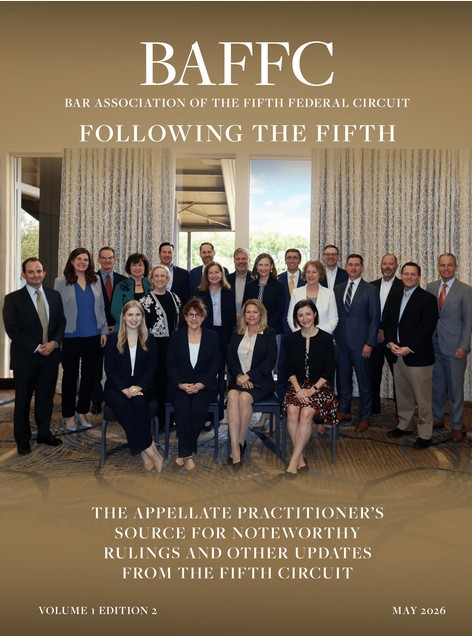
Reese v. BATF, No. 23-30033-CV (Jan. 31, 2025) (citation omitted). (A demographer would note that the average lifespan in the 1790s was about 40 years, providing some perspective on the framers’ views about aging, although that number is likely skewed downward by the high infant mortality of the time.)

While the rescission of the recent “funding freeze” memo seems to end the present dispute, history teaches that the issues will return in new form, as was seen with the travel ban at the start of the first Trump Administration, vaccine mandates, and the efforts of the Biden Administration to forgive substantial amounts of student-loan observations. “Round Two” will doubtless feature a more focused assertion of executive power by the Trump Administration, and also more sophisticated challenges to that assertion – including the selection of substantive legal arguments and the identification of plaintiffs who have strong standing positions.

A new lawsuit brought by several state AGs expands the legal claims about the “funding freeze” to include several constitutional issues – whether those additional issues survive standing / justiciability challenges remains to be seen. To date, the Administrative Procedure Act claims have focused on OMB’s authority and not the longer-term issue of just what exactly agencies are supposed to do while the “freeze” is in place – and how that comports with the APA and those agencies’ enabling statutes and mandates.

Today’s ultra-aggressive “funding freeze” memo appears to be right out of the Dobbs playbook – take an action that is not allowed under current law (the Mississippi law at issue in that case, which was plainly unconstitutional under Roe/Casey) and present it to the modern-day Supreme Court conservative supermajority.

Understandably, public comment on the memo has focused on the Nixon-era Impoundment Act. But at the courthouse, the first filed lawsuit focused on the old warhorse of the Administrative Procedure Act – the law that repeatedly stymied aggressive administrative-agency action in both the Biden and the first Trump administration.

That’s wise as a matter of substantive law – there are fruitful arguments to be made under the APA – and as a matter of avoiding the Dobbs playbook of presenting a flashy constitutional issue. “Another” APA case is simply a less compelling topic for the Supreme Court to address.

In Baker Hughes Saudi Arabia Co. Ltd. v. Dynamic Indus., Inc., the Fifth Circuit addressed the issue of arbitrability under a subcontract for an oil-and-gas project in Saudi Arabia. It reversed the district court’s decision that denied a motion to compel arbitration, holding that the dissolution of the “DIFC-LCIA” (the arbitral authority specified in the agremeent) did not make the arbitration agreement unenforceable.

The Court emphasized that the parties’ dominant purpose was to arbitrate disputes generally, rather than to arbitrate exclusively before the DIFC-LCIA, so “the forum-selection clause (if it is one) is not integral to the subcontract ….” The Court further clarified that even if the DIFC-LCIA was unavailable as a forum, the district court should have considered whether the DIFC-LCIA rules could be applied by another available forum. No. 23-30827 (Jan. 27, 2025).

The Supreme Court clarified what pleading is relevant to a remand motion in a removed action, holding:

[T]he District Court here should have remanded Wullschleger’s suit to state court. The earliest version of that suit contained federal-law claims and therefore was properly removed to federal court. The additional state-law claims were sufficiently related to the federal ones to come within that court’s supplemental jurisdiction. But when Wullschleger amended her complaint, the jurisdictional analysis also changed. Her deletion of all federal claims deprived the District Court of federal-question jurisdiction. And once that was gone, the court’s supplemental jurisdiction over the state claims dissolved too. Wullschleger had reconfigured her suit to make it only about state law. And so the suit became one for a state court.

Royal Canin USA, Inc. v. Wullschleger, No. 23-677 (U.S. Jan. 15, 2025).

A case about hydrogen sulfide exposure foundered for lack of proof as to “general causation.” In examining the materials cited by the plaintiff’s expert on that point, the Court observed:

“Although we view the reliability of expert testimony ‘in light of the totality of the evidence,’ ‘[t]he totality of the evidence cannot prove general causation if it does not meet the standards for scientific reliability established by Havner. A plaintiff cannot prove causation by presenting different types of unreliable evidence.'”

Newsome v. Int’l Paper Co., No. 24-20126 (Jan. 11, 2025).

A panel majority, after a motions panel accepted an interlocutory appeal, dismissed that appeal for lack of jurisdiction. The issue involved the appropriate measure for the calculation of “reasonable royalty” damages, and the majority reasoned:

If we reversed now, we would have no “immediate impact on the course of the litigation” because Silverthorne has not yet proven liability. The parties will proceed to trial regardless of whether we weigh in, and “nothing that we can do will prevent [the] trial.” Bear Marine, If Silverthorne fails to establish liability, our premature answer to the question will not have affected the litigation at all. Any dispute
about damages will have “evaporate[d] in the light of full factual development.” 

Even assuming arguendo that Silverthorne could establish liability, thereasonable-royalty standard may still not be controlling. Silverthorne claims that the district court’s order prevents it from proving damages. If that were true, the question could have controlled the case. As the district court noted, though, its order did “not automatically bar [Silverthorne] from proving damages,” as long as it does so according to the standard defined in [precedent].”

J.A. Masters Investments v. Beltramini, No. 24-20006 (Jan. 3, 2025) (citations and footnote omitted). A dissent had a different view of the legal issue and the section 1292 process.

“Plaintiffs contend that the district court erroneously permitted Mauro Beltramini (Beltramini’s son) to testify regarding the expenses incurred from the soccer matches when he had no personal knowledge or involvement with any of the matches. Even if that were true, Plaintiffs’ objection to Mauro’s testimony cannot be squared with their later assent to admit Joint Exhibit 1, an exhibit that included Mauro’s expenses calculations—the same exact content of his testimony. Plaintiffs have therefore waived any right to complain about it on appeal.”

J.A. Masters Investments v. Beltramini, No. 23-20292 (Jan. 3, 2025) (emphasis added).

Section 230 of the Commuications Decency Act says that no interactive computer service “shall be treated as the publisher or speaker” of third-party content. That law was of no help to a claim against Salesforce about alleged human trafficking, as the Fifth Circuit explained in A.B. v. Salesforce, Inc.:

Plaintiffs allege that Salesforce knowingly assisted, supported, and facilitated sex trafficking by selling its tools and operational support to Backpage even though it knew (or should have known) that Backpage was under investigation for facilitating sex trafficking. In essence, Plaintiffs allege that Salesforce breached a statutory duty to not knowingly benefit from participation in a sex-trafficking venture.

To state the obvious: this duty does not derive from Salesforce’s status or conduct as a publisher or speaker and would not require Salesforce to exercise publication or editorial functions to avoid liability. Rather, the duty simply requires that Salesforce not sell its tools and operational support to a company it knew (or should have known) was engaged in sex trafficking. This is not an action “quintessentially related to a publisher’s role.” Accordingly, section 230 does not immunize Salesforce from Plaintiffs’ claims.

No. 23-20604 (Dec. 19, 2024) (citations and footnotes omitted).

This notice, under Fifth Circuit precedent, abandoned the lender’s intent to accelerate a note obligation:

To the extent you have received demand letters with intent to accelerate the obligations under the above subject Note and any notice of acceleration of said Note prior to the date of this demand letter, be advised that any such demands or notices of acceleration have been withdrawn, cancelled, and abandoned.

No. 23-50662 (Dec. 20, 2024) (emphasis in original). The opinion discusses how the Circuit’s “rule of orderliness” applies to the issue at hand.

In a commerical fiduciary-duty dispute, DALF Energy v. GS Oilfield Services holds: “DALF proved each element of its breach of fiduciary duty claims based on Scribner’s falsification of production records, failure to disclose his relationship to O&GH, and failure to disclose his father’s relationship to TROFA”; and also: “DALF proved Scribner breached his fiduciary duty by placing ;P.E.’ after his name and failing to disclose his relationship to GSOS.” No. 24-50032 (Dec. 30, 2024).

Stone v. Graham, 449 U.S. 39 (1980), holds:

“Posting of religious texts on the wall  serves no such educational function. If the posted copies of the Ten Commandments are to have any effect at all, it will be to induce the schoolchildren to read, meditate upon, perhaps to venerate and obey, the Commandments. However desirable this might be as a matter of private devotion, it is not a permissible state objective under the Establishment Clause.

Unsurprisingly, then, the Fifth Circuit voted 14-3 on December 30 to reject an overly enthuastic application for en banc hearing in Roake v. Brumley – the challenge to a Louisiana law about display of the Ten Commandments that is flatly inconsistent with the above Supreme Court holding.

A complex set of appeals about the Serta bankruptcy produced this on-target introduction – not phrasing that should be used in most cases, but completely apt for these complicated finance issues:

Illustrating the choppy waters that can surround a nationwide injunction, in December, Fifth Circit judges reached three different conclusions about whether to stay the Corporate Transparency Act and related administrative rules. The motions-panel majority held:

The district court concluded that both are unconstitutional and issued nationwide injunctions against each, despite no party requesting it do so and despite every other court to have considered this issue tailoring relief to the parties before it or denying relief altogether.

The third member of the motions panel concurred in part:

[She] agrees for an expedited appeal and agrees that a national injunction is not appropriate here, so she would grant a temporary stay of the preliminary injunction pending the decision of the merits panel regarding whether to deny a stay pending appeal as to the non-parties. However, she would deny the temporary stay as to the parties (while, of course, deferring to the merits panel on this point as well), including the members of NFIB, as long as their identities are disclosed to the government.

A later per curiam order, which may have issued from the merits panel, or may simply reflect communication with that panel, reached a different conclusion:

The merits panel now has the appeal, which remains expedited, and a briefing schedule will issue forthwith. However, in order to preserve the constitutional status quo while the merits panel considers the parties’ weighty substantive arguments, that part of the motions-panel order granting the Government’s motion to stay the district court’s preliminary injunction enjoining enforcement of the CTA and the Reporting Rule is VACATED.

These changes show how minor variations in panel makeup can have profound consequences when nationwide equitable relief is at issue. (The party-presentation issue referred to by the motions-panel majority is also addressed in my recent Cornell Law Review essay.)

In Alliance for Fair Board Recruitment v. SEC, the en banc Fifth Circuit held that the SEC should not have approved Nasdaq’s “Board Diversity Proposal.”

The Court reminded that the Act is focused on protecting investors from speculative, manipulative, and fraudulent practices, and promoting competition in the securities market; therefore: “SEC may not approve even an a disclosure rule unless it can establish the rule has some connection to an actual, enumerated purpose of the Act.” It rejected the SEC’s argument that the proposal would satisfy investor demand for diversity information, holding: “The purpose of satisfying investor demand for any and every kind of information about exchange-listed companies is not remotely similar to any of those stated purposes.” 

Cf. McCullough v. Maryland,17 U.S. 316 (1819) (“Among the enumerated powers, we do not find that of establishing a bank or creating a corporation. But there is no phrase in the instrument which, like the articles of confederation, excludes incidental or implied powers; and which requires that everything granted shall be expressly and minutely described.”).

The Court also found support for its holding in the major questions doctrine, given the expansive regulatory authority that it concluded would be needed for the SEC to implement the proposal. A dissent argued that the SEC had received substantial evidence that investors sought standardized information on board diversity, and noted the SEC’s limited statutory authority to review the rules of Nasdaq, a distinct and private entity (albeit one that is heavily regulated). No. 21-60626, Dec. 11, 2024 (9-8 vote).

Judge Oldham’s thoughtful dissent from the recent wreckage of an en banc proceeding provides fascinating historical background about courts’ traditional focus on decisions rather than opinions. That basic concept about the operation of appellate courts is useful in distinguishing holding from dicta, identifying the appropriate scope of appellate review, and clarifying questions about the law of the case / res judiciata effect of earlier judgments.

By including Roman courts in its historical review, the opinion reminds how much the American system has borrowed from the civilian tradition – a point of particular interest in Texas, where opinions from the 1840s by the Republic of Texas Supreme Court vividly illustrate the jostling between the English/American and Spanish/French systems on issues of property law at that time.

The case of Chaudhary Law Firm, P.C. v. Ali reminds: “It is more than well-settled that only an aggrieved party may appeal a judgment.”  A party is not considered “aggrieved” if they have received a favorable judgment, even if the trial court made subsidiary findings or conclusions that were unfavorable to them.

The Court emphasized that “appellate courts review judgments, not opinions,” and a winning party “may not appeal for the sole purpose of seeking a more favorable opinion from the [trial] court.” The Court noted some situations that could warrant a relaxation of this principle, none of which were present in this case, where the defendant law firm obtained complete dismissal on the merits. No. 23-20362 (Dec. 9, 2024).

Savoie v. Pritchard affirmed that there is “life within” the fiduciary shield doctrine in Louisiana law. The doctrine prevents the exercise of personal jurisdiction over a corporate officer based solely on their corporate acts, and is “rooted in the principle that the acts of a corporate officer in his corporate capacity cannot form the basis for jurisdiction over him in an individual capacity.”  In this Erie case, the Fifth Circuit found implicit recognition of the doctrine in a Louisiana Supreme Court case.

The Court emphasized that “contacts made in [the defendant’s] corporate capacity do not count against him for purposes of personal jurisdiction unless one of two exceptions apply: (1) the defendant allegedly engaged in a tort for which he may be personally liable, or (2) the plaintiff demonstrates cause to pierce the corporate veil.”  No such claim was pleaded here or shown here, so the fiduciary shield doctrine barred personal jurisdiction over the defendant. No. 23-30783, Nov. 25, 2024.

This week, the Eastern District of Texas enjoined a sweeping set of Treasury regulations about disclosure of beneficial ownership, concluding that the Corporate Transparency Act and related regulations exceeded Congress’s constitutional powers. The Northern District of Texas rejected Boeing’s plea bargain of charges related to the 737 MAX debacle, concluding that inappropriately required consideration of race in selecting the monitors for a program that would administer Boeing’s compliance with agreed obligations going forward. The Boeing ruling may yet be resolved in the trial court, as the judge asked the parties to report back in 30 days, but the CTA case will certainly be headed to the Fifth Circuit soon.

In Van Loon v. Dep’t of the Treasury, the Fifth Circuit addressed the Treasury Department’s authority to regulate “property” under the International Emergency Economic Powers Act. After a detailed explanation of the blockchain technology involved, the Court held that certain “immutable smart contracts” do not qualify as “property” under IEEPA. The Court emphasized that “property” must be capable of being owned, and since the immutable smart contracts are unchangeable and unremovable, they cannot be owned or controlled by any entity, including their creators.

The Court further clarified that even under the Treasury’s own regulatory definitions, the immutable smart contracts do not fit within the scope of “property.” The court noted that these smart contracts are neither contracts nor services, as they do not involve any human effort or control once they are deployed. No. 23-50669 (Nov. 26, 2024).

In Willis v. Barry Graham Oil Service, L.L.C., the Fifth Circuit read the relevant contract provisions differently than the district court.

The district court concluded that Barry Graham Oil Service did not fall within the defense, indemnification, and insurance provisions of the Master Services Contract (MSC) between Shamrock Management and Fieldwood Energy. Specifically, it found that Graham was not covered by the MSC’s indemnity provisions because it was not part of the “Third Party Contractor Group” defined in the contract.

The Fifth Circuit held that Graham was covered under the MSC’s indemnity provisions. The MSC required Shamrock to “release, indemnify, protect, defend, and hold harmless such other Third Party Contractor(s) (and any such Third Party Contractor Group),” from claims arising from injuries to Shamrock’s employees.

Therefore, Graham, as part of Kilgore Marine Services’ Third Party Contractor Group, was entitled to indemnification. The contractual trigger for these obligations—cross indemnification “substantially similar” to Shamrock’s—was satisfied, obligating Shamrock to defend and indemnify Graham. No. 23-30609, Nov. 20, 2024.

In State of Texas v. U.S. Dep’t of Homeland Security, the Fifth Circuit addressed a challenge by Texas to a federal plan to cut razor wire installed by Texas at a border crossing. A 2-1 opinion ordered entry of a preliminary injunction against the planned wire-cutting.

The panel majority held the Administrative Procedure Act “clearly waives the United States’ sovereign immunity for Texas’s common law claims,” allowing Texas to seek injunctive relief against federal agencies and officers. In particular, Texas’s claims sought non-monetary relief and were based on the destruction of its property, which falls under the definition of “agency action” in the APA.

The majority also held that Texas showed a strong likelihood of success on its state law trespass-to-chattels claim–the concertina wire is state property, and Texas had shown that the federal agents’ actions were not justified by any exigency or statutory authority. As a result, the court granted Texas’s request for a preliminary injunction, enjoining federal agents from damaging or interfering with Texas’s concertina wire fence.

A dissent argued that Texas did not show the alleged “wire-cutting policy” constituted final agency action, which is a prerequisite for judicial review under the Administrative Procedure Act (APA). It also concluded that Texas’s state law claims were barred by intergovernmental immunity, as applying Texas tort law to federal agents would improperly control federal operations. No. 23-50869 (Nov. 27, 2024).

Cocroft v. Graham  addressed the constitutionality of Mississippi’s restrictions on medical marijuana advertising. Since marijuana remains illegal under federal law, including for medical purposes, Mississippi can lawfully restrict advertising related to it. The Fifth Circuit emphasized that “the First Amendment poses no obstacle to a ban on such speech” because the underlying commercial activity is not lawful under federal law.

Specifically, the Court rejected the plaintiffs’ argument that only the sovereign enacting the underlying prohibition (in this case, the federal government) could restrict related commercial speech. The Supremacy Clause ensures federal law’s primacy, making marijuana illegal in every state, including Mississippi. Therefore, Mississippi’s restrictions on medical marijuana advertising are constitutionally permissible. No. 24-60086, Nov. 22, 2024.

Jones v. Reeves grounded the long-flying litigation about governance of the Jackson Airport, observing:

There is also a fundamental disconnect between the Plaintiffs’ theory of employment-related injury, i.e. loss of per diem and travel reimbursement, and the remedy they seek, which is an injunction preventing abolition of the [Jackson Municipal Airport Authority]. … The elimination of JMAA and its replacement by the [Jackson Metropolitan Area Airport] Authority is the crux of this case. JMAA Commissioners’ per diem and travel expenses compensate and reimburse them only for their official duties as appointees. If the seat to which these duties are owed disappears, so too does the need for any associated reimbursement or compensation. With the elimination of the JMAA, there are no official duties requiring a per diem; and in the absence of JMAA -related travel expenses, there is nothing to reimburse.

No. 24-60371 (Nov. 19, 2024). Accordingly, the Court dismissed the case because the plaintiffs lacked individual standing, as their injuries were “institutional” and not personal.

Contractual ambiguity is easily the #1 issue, in commercial cases, where thoughtful judges disagree. An example appears in Barrios v. Centaur LLC, where both the district court and the Fifth Circuit concluded that a maritime contract had two conflicting “escape” (i.e., “other insurance”) clauses. The district court found ambiguity, but the Fifth Circuit applied a Louisiana rule that “when faced with two escape clauses threatening coverage, courts must find them ‘mutually repugnant’ and make both policies liable for the claim” on a pro rata basis. No. 23-30892 (Nov. 15, 2024).
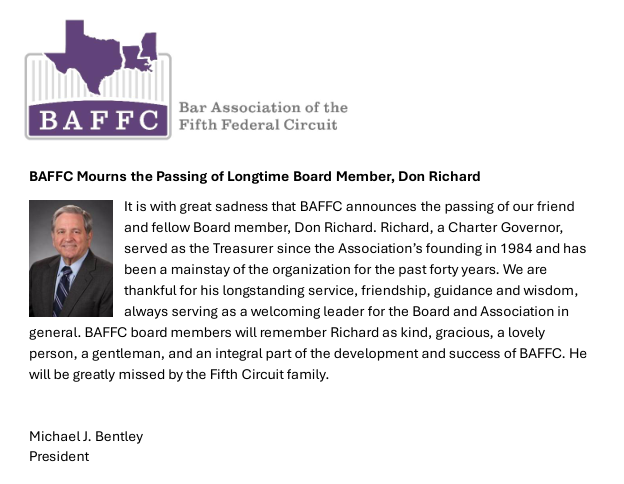
Texas Tribune v. Caldwell County affirms the right of public (and with it, pres) access to pretrial bail hearings, noting, inter alia:

Public access to bail hearings helps ensure, for example, that courts act fairly and justly in setting bail.46 When courts hold private proceedings, “[t]hey can . . . avoid criticism and proceed informally and less carefully.” Allowing public access encourages adequate preparation and, in turn, precision by the court. These assurances lead to “enhance[d] public confidence in the process and result” of the justice system.

The opinion also provides a sleek example of the “citational footnote” writing style that I believe significantly enhances readability. No. 24-50135 (Nov. 15, 2024).


The majority opinion in National Center for Public Policy Research v. SEC found that a challenge to an SEC rule about the contents of proxy ballots was not justiciable, noting, inter alia:

     “[C]onsider the chain of assumptions the Center’s theory requires. First, we must anticipate that third-party companies uninvolved in this litigation will choose to exclude the Center’s measure in their proxy materials. We must do so mindful that many companies have since opted to include the Center’s measure without SEC intervention.   

       Next, we must assume the same third-party companies will base their exclusion decision on the same grounds as Kroger and seek SEC staff advice. No matter that at least thirteen independent reasons exist for excluding proxy statements, or that the SEC staff is under no obligation to offer its advice if requested.

     We must further assume that the SEC will issue the same no-action letter sent to Kroger, disregarding that staff advice is limited to each ‘particular instance.’ If SEC staff issues the letter, we must also infer that the third-party companies will ultimately follow through with their initial decision and exclude the proposal from their proxy materials.”

No. 23-60230 (Nov. 14, 2024) (emphasis added); accord FDA v. Alliance or Hippocractic Medicine, 144 S. Ct. 1540 (2024) (“The doctors have not shown that FDA’s actions likely will cause them any injury in fact. The asserted causal link is simply too speculative or too attenuated to support Article III standing.”). A dissent characterized thematter as one capable of repetition yet evading review.

Last Friday I received the inaugural “Lawyer’s Lawyer” award from the Dallas Bar Association, described by President Bill Mateja as a lawyer who “eats, breathes, and sleeps law” in comment and public thought about it. (Next to me is Courtney Marcus, filling in for Glenn West, who also received it.) Many thanks to Bill and the DBA, and to readers of this blog: longtime or new; enthusiastic or not!

Classically, judicial opinions consist of dicta and holding; the process of distinguishing the two and applying the correct rule of law in a specific case is the essence of the common-law method. A variant on that classical model sometimes arises in cases on remand from the U.S. Supreme Court, when the panel discusses that Court’s mandate; an example of which appears in the remand of NetChoice LLC v. Paxton, No. 21-51178 (Nov. 7, 2024).
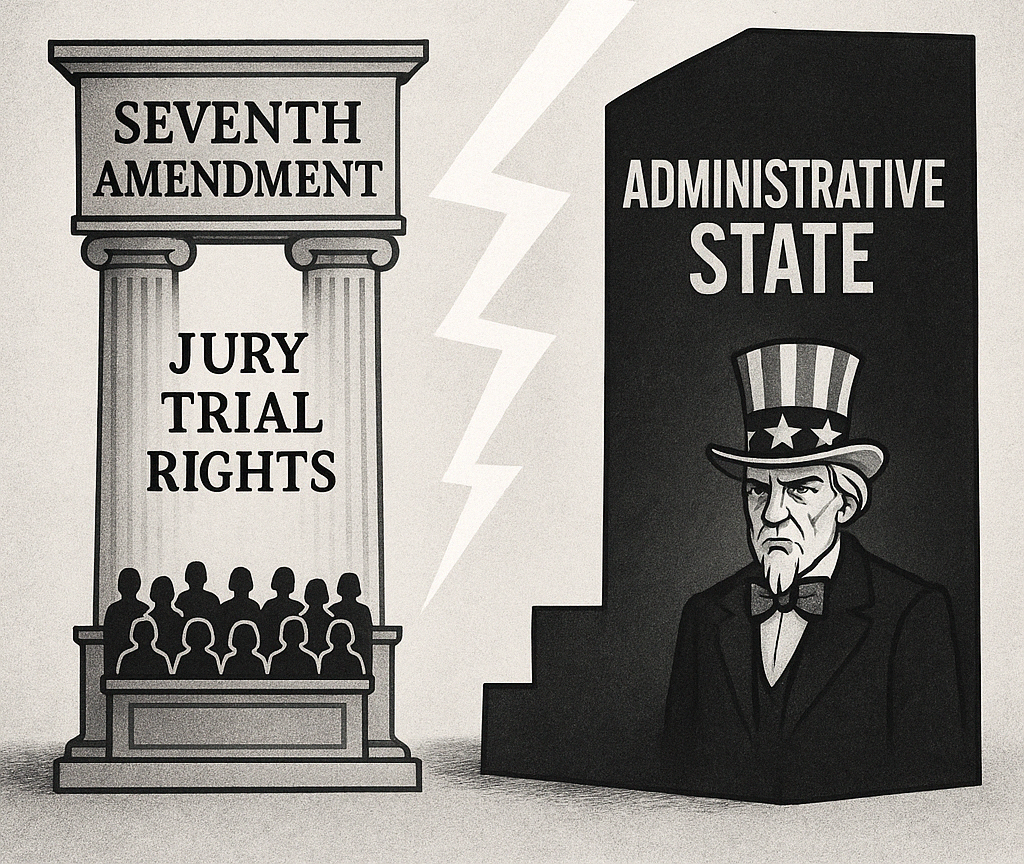
The appellants in Legacy Recovery Servcs, LLC v. City of Monroe tried mightily, but was unable to persuade the Fifth Circuit that it had appellate jurisdiction over an order that partially granted and denied motions to dismiss.

The appellants argued that the ruling was an appelable collateral order. The Court saw otherwise, holding that the order did not “conclusively determine the disputed question” because it dismissed some claims while retaining others. Exercising jurisdiction over such an order risked encouraging piecemeal appeals that would require the Court to review the same intertwined claims multiple times.

Also, the issues resolved by the district court were not “completely separate from the merits of the action.” The dismissed and retained claims were based on the same statutes, and thus interwoven with the issues left  before the district court.

Lastly, the Court held that the order was not “effectively unreviewable on appeal from a final judgment,” pointing out that if the appellants’ concerns were valid, the Court could vacate the judgment and order a new trial after final judgment. No. 24-30211 (Nov. 6, 2024).

Even the most enthusiastic perspectives about federal-court jurisdiction have limits, as shown by Lowery v. Texas A&M Univ., a discrimination case filed by a college professor:

“Professor Lowery says that he is ‘able and ready’ to apply for lateral positions at [Texas A&M] University. But he never submitted an application to substantiate his interest. That fact is fatal in this case because there is little evidence that submitting a job application would be a futile gesture.”

No. 23-20481 (Oct. 30, 2024) (emphasis added).

Repub. Nat’l Comm. v. Wetzel  held that a Mississippi statute, allowing absentee ballots to be received up to five days after Election Day, is preempted by federal law, which mandates that all ballots must be received by Election Day. The court emphasized that the term “Election Day” refers to a singular day. Slate’s Mark Stern offers some provocative commentary about the potential impact – or lack thereof – of this ruling. No. 24-60395, Oct. 25, 2024.

In a per curiam opinion joined by eight judges, the Fifth Circuit held in Tesla v. NLRB that an NLRB decision about unfair labor practices by Tesla would be vacated and remanded for further proceedings:
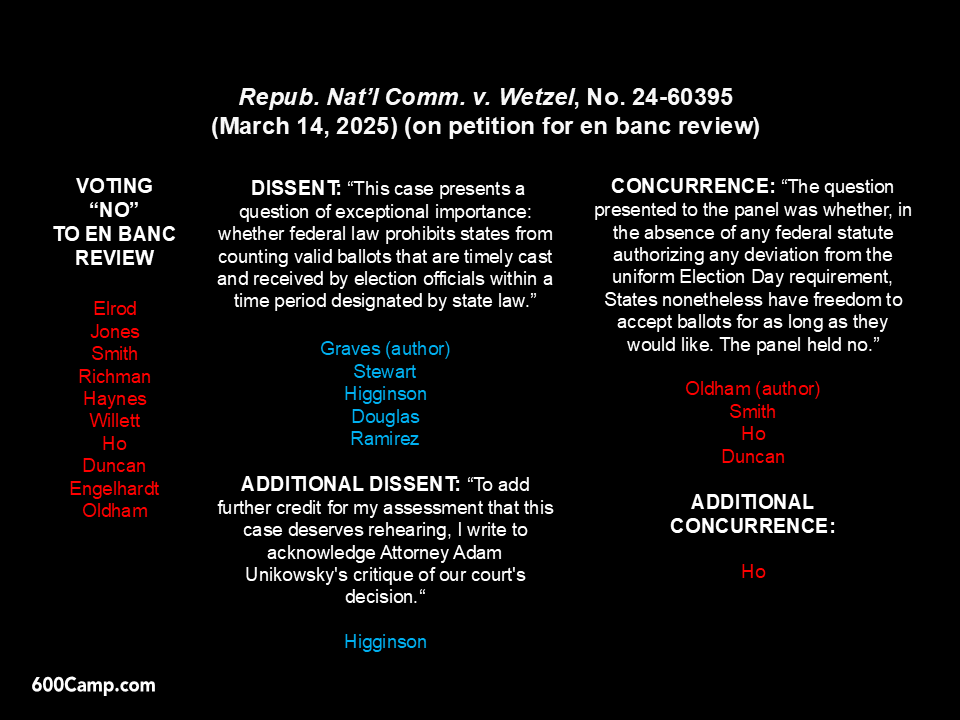

We hold that Musk’s tweets are constitutionally protected speech and do not fall into the categories of unprotected communication like obscenity and perjury. And the Board does not dispute the general rule that it (like every other part of the Government) is powerless to delete protected speech.

But nine other judges didn’t join that opinion. As detailed below, Judge Haynes concurred in the judgment only, and eight judges joined a dissent. So what the NLRB is supposed to do on remand is not entirely clear.


Crosswell v. Rodriguez involved the sufficiency of a RICO pleading. The Fifth Circuit emphasized a RICO enterprise “must exist for purposes other than just to commit predicate acts,” which means that  “accusing a group of defendants comprising one natural person and a collection of legal fictions as undertaking a set of acts together, without providing any detail as to how they acted together, fails to provide a factual basis from which to plausibly infer the connected structure of an association.”

Here, while the plaintiffs’ allegations described a stand-alone set of events, the Court held that no allegations plausibly supported the theory that these transactions were part of a repeated and continuing scheme involving the defendants. No. 23-20535, Oct. 17, 2024.

In X Corp. v. Media Matters for Am., the Fifth Circuit granted a stay pending appeal of a a district court’s discovery order compelling Media Matters to disclose its donor information, citing First Amendment concerns.

The Court emphasized the loss of First Amendment freedoms, even for minimal periods, constitutes irreparable injury, and that the public interest is better served by avoiding the risk of a chilling effect on association, as “First Amendment freedoms need breathing space to survive.” The Court also noted the breadth of the discovery requests, proportionate to the needs of the case, and the risk that disclosure of the requested information could lead to harassment or intimidation of Media Matters and its donors. No. 24-10900, Oct. 20, 2024.

In Ultra Deep Picasso Pte. Ltd. v. Dynamic Indus., the Fifth Circuit addressed the critical issue of where a bank account can be garnished in an “in rem” proceeding grounded in admiralty law. Applying the general principle that the property must be found within the district where the trial court is located, the Fifth Circuit concluded that a bank account is located where its funds can be withdrawn — a standard that requires the physical presence of the bank or its branches within the district.

The court rejected the argument that it’s enough to have jurisdiction in the district over the garnishee bank. In rem jurisdiction “rests on the attaching court’s jurisdiction over both the garnishee and the property to be attached.” Because the garnishee bank didn’t have a branch in the district, but only a “representative office” with limited authority, the garnishment failed. No. 23-20357, Oct. 18, 2024.

Last week I touched on one significant copyright holding from UMG Recordings v. Grande Communications Networks. In that case, the Fifth Circuit also addressed the calculation of statutory damages under the Copyright Act.

Specifically, the Court held that statutory damages should be awarded per compilation (e.g., an album) rather than per individual work within the compilation. The court emphasized that the plain language of the Copyright Act mandates that “all the parts of a compilation or derivative work constitute one work” for the purposes of statutory damages.

This conclusion means that when multiple songs from the same album are infringed, the copyright owner is entitled to only one statutory damage award for the entire album, not separate awards for each song. The Court rejected the district court’s approach, which allowed separate statutory damages for each individual song. In so doing, the Fifth Circuit noted that many of the works in question were registered as compilations, with certificates of registration indicating notations such as “collective work” or “compilation of sound recordings.” No. 23-50162, Oct. 9, 2024.

In UMG Recordings v. Grande Communications Networks, the Fifth Circuit held that an internet service provider materially contributed to copyright infringement, by continuing to provide internet services to known infringing subscribers, without taking basic measures to prevent further infringement. As potential safety measures, the Court noted that the ISP could have terminated the accounts of repeat infringers (a measure that Grande had previously employed) or required infringing subscribers to contact the company to maintain their services No. 23-50162, Oct. 9, 2024.

In La Union del Pueblo Entero v. Abbott, the Fifth Circuit stayed an injunction against a Texas election law, emphasizing that the injunction was issued just three weeks before voting was set to begin–and after Texas had already started issuing mail-in ballots for the 2024 general election.  A concurrence focused solely on the issue of timing and did not address the merits issues that the panel majority also reviewed. No. 24-50783, Oct. 15, 2024.

The 2008 financial crisis produced a bumper crop of Fifth Circut opinions about basic issues involving home loans, because diversity jurisdiction drove much of that litigation into the federal courts. While (thankfully) there are far fewer cases about those issues now, the Fifth Circuit still writes in that important area, most recently in Couch v. Bank of New York Mellon, holding:

  • Clock for foreclosure. “The Couches contend that [CPRC] § 16.025(a) and (b) require mortgagees to file suit and sell within four years to preserve the lien. Texas courts disagree. Section 16.035(a) ‘does not require that the actual foreclosure occur within the four-year limitation period, but rather, requires only that the party seeking foreclosure “bring suit … not later than four years after the day the cause of action accrues.”‘”
  • Clock for adverse possession. “[T]he adverse possession clock did not start until the Bank acquired the property at the constable’s sale. The Couches have not adversely possessed the property for a sufficient period of time under any of the potentially applicable periods.”

No. 24-10297 (Oct. 11, 2024, unpublished).

The Fifth Circuit said “enough” as to a district court’s aggressive oversight of the Texas foster-care system, vacating a contempt order and requiring reassignment of the case on remand. Capturing the flavor of the opinion, towards the end of the section on reassignment, the Court said:

However, as a general rule of law federal judges are not allowed to become permanent de facto superintendents of major state agencies. Horne v. Flores, 557 U.S. 433, 453, 129 S. Ct. 2579, 2597 (2009) (“[T]he longer an injunction or consent decree stays in place, the greater the risk that it will improperly interfere with a State’s democratic processes.”); United States v. Mississippi, 82 F.4th 387, 400 (5th Cir. 2023) (“Micromanagement, enforced upon threat of contempt, does not reflect the principles of comity” in prison context.). Nor, under the federalist structure created by the Constitution, is it appropriate for federal court intervention to thwart the state’s self-management, where the state is taking strides to eliminate the abuses that led to the original decree. Horne, 557 U.S. at 448, 129 S. Ct. at 2593–94 (“Federalism concerns are heightened” where “a federal court decree has the effect of dictating state . . . budget priorities.”). Nor are federal judges even suited, by training or temperament, to manage institutions, personnel, or the provision of vital state services, even if counselled by monitors.

M.D. v. Abbott, No. 24-40248 (Oct. 11, 2024).

In RSM Prod. Corp. v. Gaz du Cameroun, S.A., the Fifth Circuit reversed the district court’s decision to vacate a revised arbitral award that reduced the damages awarded from $10.5 million to $6.5 million. The Court held that the arbitral tribunal had the authority to correct “computational errors” in its initial award and to determine what constituted such errors under the International Chamber of Commerce Rules, which the parties’ agreements incorporated. Applying the highly deferential standard of review for such issues, the Court held that the tribunal “arguably construed the parties’ contracts” when it issued the corrected award, even if it made a mistake in its interpretation.

The Court rejected RSM’s argument that the tribunal exceeded its powers by reconsidering the merits of RSM’s claims. Distinguishing RSM’s authority, the Court noted that the ICC rules allowed this tribunal to correct any “clerical, computational or typographical error, or any errors of similar nature contained in [the] award.” The Court emphasized that “[t]he potential for … mistakes is the price of agreeing to arbitration” and that “[t]he arbitrator’s construction holds, however good, bad, or ugly.” No. 23-20583, Sept. 19, 2024.

Hon. Jennifer Walker Elrod has taken office as the new Chief Judge of the Fifth Circuit, succeeding Hon. Priscilla Richman. The Texas Lawbook has a good story on this “changing of the guard” for this critical leadership role. The new Chief tells the Lawbook:

“I believe that we are all in this endeavor together to uphold our Constitution and try to follow the rule of law and this enterprise works best when everyone gets to participate and have their say … And we can learn from each other if we’re all at liberty to engage. … I also believe iron sharpens iron … by learning what others who think differently believe, and what the basis for that belief is, that can help you to better reinforce your view, or perhaps, to change your mind.”

Cure & Assocs., P.C. v. LP Fin., LLC addreses whether nonsignatories to an arbitration agreement can be compelled to arbitrate under state-law equitable estoppel principles. The Fifth Circuit held that these nonsignatories could be compelled, because they  received direct benefits from the contractual relationship between the two signatories. Specifically, the Court noted that one of the nonsignatories was formed specifically to facilitate one signatory’s business with the other, sharing clients, employees, and office space. Under both California and Texas law, a nonsignatory can be compelled to arbitrate if it “deliberately seeks and obtains substantial benefits from the contract” with an arbitration clause. No. 23-40519, Oct. 1, 2024.

Follow by Email
Twitter
Follow Me