 In Simmons v. Brotherhood Mutual Insurance Co., the Fifth Circuit confronted an ambiguous district-court order resolving competing motions for partial summary judgment in an insurance-coverage dispute. Rather than dismissing the appeal for want of final judgment, the court ordered a remand “for the limited purpose of permitting the district court to issue final judgment” within fourteen days while retaining jurisdiction over the appeal. That procedure allows the district court to enter a final judgment to support § 1291 jurisdiction without requiring a new notice of appeal or additional appellate briefing. No. 25-30463 (May 15, 2026).
Monthly Archives: May 2026
Here is my paper from my “Fifth and Fifth” presentation today at the DBA Appellate Section meeting at the Arts District Mansion.
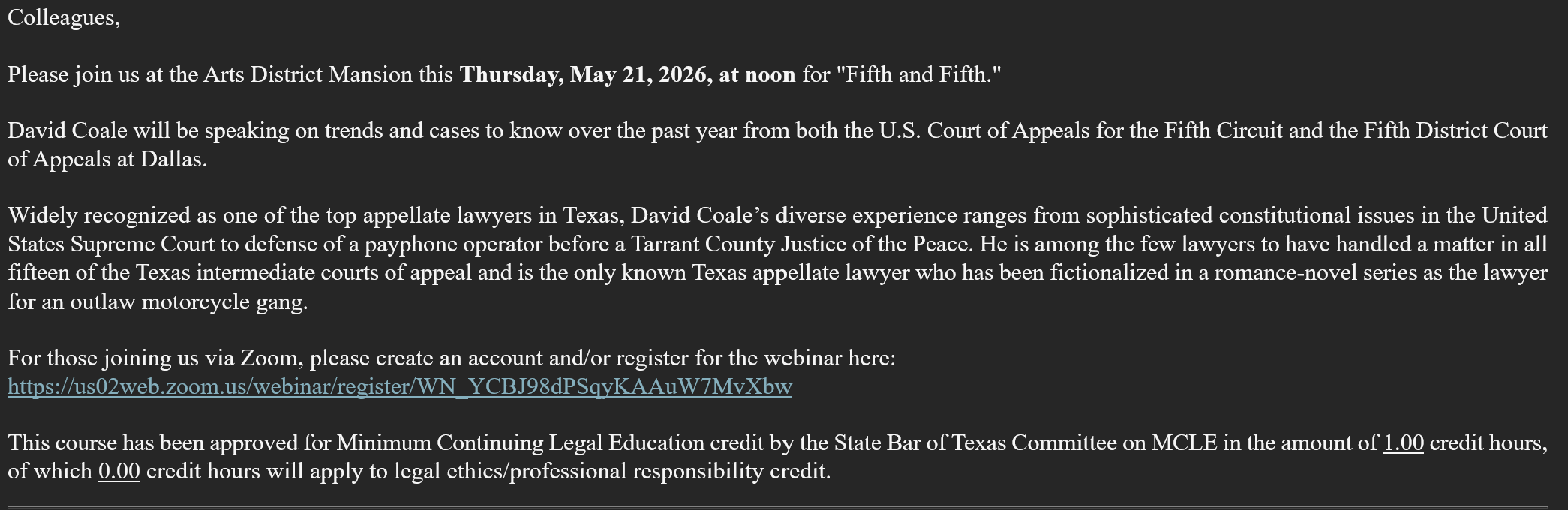
Come to the Arts District Mansion this coming Thursday, the 21st, for my yearly “Fifth and Fifth” case-law update!
 In Fleming v. Black Diamond Capital Management, L.L.C., the Fifth Circuit affirmed a judgment that a private equity sponsor was not liable under the Worker Adjustment and Retraining Notification (WARN) Act for a portfolio company’s mass layoff, because plaintiffs failed to prove the sponsor “specifically directed” the plant closing that triggered the layoffs.
The panel acknowledged circumstantial evidence that the sponsor exercised pervasive influence over its portfolio company’s operations, but cautioned that proof of general control was not the same as proof of specific direction of the challenged decision. A dissent argued that the majority’s narrow framing of de facto control will make it nearly impossible for plaintiffs to prevail absent an admission of fault by the parent. No. 24-30291 (May 11, 2026)
 In Conyers v. Kellogg Brown & Root, Inc., the Fifth Circuit addressed whether a qui tam relator may recover attorneys’ fees under the False Claims Act when the Government intervenes, drops the relator’s original claims, and the relator receives no share of the settlement proceeds.
Applying the “rule of the last antecedent” to 31 U.S.C. § 3730(d)(1), the court affirmed the denial of the relator’s fee motion, holding that the statute’s reference, to “such person” who “shall also receive” reasonable expenses and attorney fees, refers to the person who received payment from the proceeds. The court thus condluded that “a relator may only recover attorney fees and costs if he received a relator’s share of the proceeds of the action or settlement.” This decision aligns the Fifth with similar holdings in the Sixth and First Circuits on this point. No. 25-20194 (May 7, 2026)
 In Trojan Battery Co. LLC v. Golf Carts of Cypress, LLC, the Fifth Circuit affirmed the district court’s finding of a likelihood of confusion between the plaintiff’s TROJAN® marks for golf-cart batteries and the defendant’s TROJAN-EV mark for golf carts. The court applied the eight “digits of confusion” as follows:
- Strength of the mark. The court held that the TROJAN® marks are strong due to “decades of use, marketing to a broad range of golf industry consumers, hundreds of millions in sales, a large market share, and the well-known reputation of the TROJAN® brand in the golf cart market.” The court rejected the argument that third-party uses—such as Trojan condoms and the USC mascot—weakened the mark, finding no evidence that those uses diminished the public’s association of TROJAN® with Trojan Battery within the golf-product marke
- Similarity of the marks. The court found the marks highly similar because they share the dominant word “TROJAN,” and even though the logos differ, the marks are used in a way in which “a reasonable person could believe the two products have a common origin or association.”
- Similarity of the products. The court held that golf-cart batteries and golf carts are “highly related” complementary products often used and sold together, and that consumers could believe the senior user would naturally expand into the golf-cart market.
- Identity of retail outlets and purchasers. Conceded by the defendants, as both parties sell primarily through the same golf-cart retail stores to the same customers.
- Identity of advertising media. Also conceded by the defendants, as both parties use the same advertising channels.
- Intent. he court affirmed the district court’s finding that the defendant’s principal intended to trade on the plaintiff’s goodwill, crediting evidence that he sold golf carts equipped with TROJAN® batteries and negotiated purchases of TROJAN® batteries before founding Trojan EV, and finding his testimony that he was unaware of the TROJAN® brand “not being truthful”–a finding due considerable deference under the standard of review.
- Actual confusion. The court found clear error—holding that five instances of confusion over roughly two and a half years of concurrent sales running into the millions of dollars were “insufficient to sustain a finding of likelihood of confusion,” applying the Amstar
- Degree of care. The court found no clear error, noting that even sophisticated purchasers such as an experienced golf-cart dealer initially believed Trojan EV was affiliated with Trojan Battery, and that “a high price tag alone does not negate other indicia of likelihood of confusion, especially if the goods or marks are similar.”
No. 25-20243 (5th Cir. May 8, 2026).
 In Hill v. Jackson Offshore, the Fifth Circuit vacated a district court order that denied a motion to compel arbitration and allowed discovery into an arbitration agreement’s enforceability.
The case involved a seaman who signed a wage and benefits agreement containing both an arbitration clause and a delegation clause, which said that “any dispute relating to the validity, interpretation, or application of this Agreement shall be submitted to the arbitrator for resolution.”
Applying Rent–A–Center, the Court reminded that a party resisting arbitration must make arguments “specific to the delegation provision,” and not argue generally that “the contract as a whole (including its arbitration provision) is rendered invalid.” Although the seaman’s briefing stated that he challenged “both the entire Agreement, as well as the arbitration language or ‘clause’ specifically,” the Court found these efforts insufficient because the seaman never explained how fraud or duress applied to the delegation clause differently than to the rest of the agreement.
No. 24-30554, May 5, 2026.
 The Fifth Circuit recently voted to rehear en banc the panel opinion in Aramark Services v. Aetna, which involves a question about ERISA remedies and whether Circuit precedent comports with Supreme Court opinions in the area. The panel concurrence that prompted en banc review makes an intriguing observation about dicta and its precedential value:
Montanile does not distinguish Amara factually based on the identity of the Amara defendant as a fiduciary. Moreover, rarely has the Supreme Court so thoroughly distanced itself from “dicta” in a previous case. To have purported to “overrule” this point in Amara, after all, would not have comported with Amara itself, which recognized its statements as dicta and mere ruminations. A court cannot “overrule” its own dicta, which were never precedential to begin with.
(emphasis added).