This week, the Fifth Circuit’s website reports the following about Judge Dennis taking inactive senior status:

As of February 23, 2026, Judge James L. Dennis has taken inactive senior status. After serving in the United States Army, Judge Dennis graduated from Louisiana Tech University and Louisiana State University Law School. After graduating law school, he worked in private practice and served as a state representative in the Louisiana House of Representatives. He then became a state judge in Louisiana, serving on the Louisiana District Court, Fourth Judicial District; the Louisiana Court of Appeal, Second Judicial Circuit; and the Supreme Court of Louisiana. He has served honorably on this court for just over thirty years. We thank him for his long and distinguished service to this court and our country.

Two recent opinions – one from the Fifth Circuit, one from the Southern District of Texas – have addressed constituaional challenges to state education laws, and turned on issues of procedure.

In Roake v. Brumley, the Fifth Circuit, sitting en banc, vacated a preliminary injunction against Louisiana House Bill 71, which requires public schools to display the Ten Commandments in every classroom. The court did not rule on whether the law is constitutional; instead, it held that the challenge was not ripe for judicial decision because the statute confers discretion on local school boards regarding the nature of the displays, and the full context of how the law will be implemented remains unknown. Dissenting opinions would have addressed the merits.

And in GSA Network v. Morath – a district court opinion on an issue that is likely to reach the Fifth Circuit at some point – the court enjoined the Houston, Katy, and Plano Independent School Districts, barring them from enforcing several provisions of Senate Bill 12, a law regulating clubs, curriculum, and policies related to sexual orientation and gender identity in public schools. The court found that the three school districts, though actively implementing SB 12, explicitly declined to defend the law on the merits, filing only brief responses that took “no position” on its constitutionality, creating a waiver under party-presentation principles. And although the Commissioner of the Texas Education Agency did offer a defense, the court dismissed him from the case for lack of standing, finding that the plaintiffs’ injuries were traceable to the school districts themselves—not the Commissioner—because SB 12 vests implementation and enforcement authority in local school boards.


There have been two recent opinions about generative AI that you should know about

  1. The Southern District of New York recently held that a client’s queries of ChatGPT about a lawsuit WERE NOT PRIVILEGED. My law partner Chris Schwegmann has an excellent analysis of that ruling and its practical implications in this recent Texas Lawbook article. I highly recommend it, Chris is way ahead of the curve in thinking about “what next?” after this important ruling.
  2. The Fifth Circuit has had it with the scourge of hallucinated citations (iillustrated, fittingly, by generative AI to the right), and recently sanctioned a lawyer $2,500 for filing a brief with 21 shady citations (and evasive followup when asked about them). The case is Fletcher v. Experian and here is my recent Texas Lawbook article about it, and some practical lessons that it teaches (namely: (a) “don’t eat soup with a fork,” using general-purpose AI products for the wrong purposes; (b) don’t ignore “red flags” about citations and quotes that are too good to be true; and (c) if you make a mistake, for goodness sakes just apologize and move on, rather than trying to stall an obviously upset judge or judges.)

My friend Art Ayala recently visited the Texas Appellate Law Podcast to discuss the complexities of securing supersedeas bonds when a client faces an adverse verdict. Key topics include:

Timing: Why counsel should consider advising clients to initiate the bonding conversation even before a judgment is entered.
Process: How process typically flows from the initial call with a client to bond issuance.
Collateral Options: Pros and cons of various collateral options.

You can listen to the full conversation here: Supersedeas Bonds in the Real World.

In Associated Prof. Educators of La. v. EDU20/20, LLC, the Fifth Circuit addressed a classic “bad leaver” case about a former employee who had worked for his employer and a competitor at the same time.

On the employer’s Lanham Act claim, the court reversed summary judgment in favor of the defendants, holding that declarations from two attendees who assumed an affiliation between competing educational organizations, based on the defendant’s use of the plaintiff’s logo in presentations, constituted competent evidence of actual confusion. The Court emphasized that at the summary judgment stage, inferences must be drawn in favor of the nonmovant, and “misdirected inbound inquiries,” such as emails sent to the wrong organization, “are ‘indicia of actual confusion.'”

On the trade secret claims, the court affirmed summary judgment for the defendants. The Court held that the plaintiff’s mentor-training materials did not qualify as trade secrets because they were shared with training participants who had no confidentiality obligations. As to a client list that the plaintiff alleged was misappropriated, the Court held that the plaintiff failed to demonstrate with competent summary judgment evidence that the list even existed. And as for a member database, the court determined that the information it contained-largely contact details of educators employed by Louisiana public schools-was readily ascertainable through public records requests and thus did not constitute a protectable trade secret.

No. 24-30640, Feb. 16, 2026.

In Vapor Tech. Ass’n v. Graham, “[a] group of retailers, distributors, and trade associations” challenged a state law about “vaping” equipment. The Fifth Circuit held that they lacked standing: “Rather than identify a particularized constitutional injury of their own, they assert a generalized grievance: that Mississippi has enacted and seeks to enforce a statute allegedly inconsistent with federal law. But a generalized interest in constitutional governance, standing alone, is insufficient to confer standing. Article III bars federal courts from resolving such abstract disputes.” No. 25-60694 (Feb. 11, 2026).

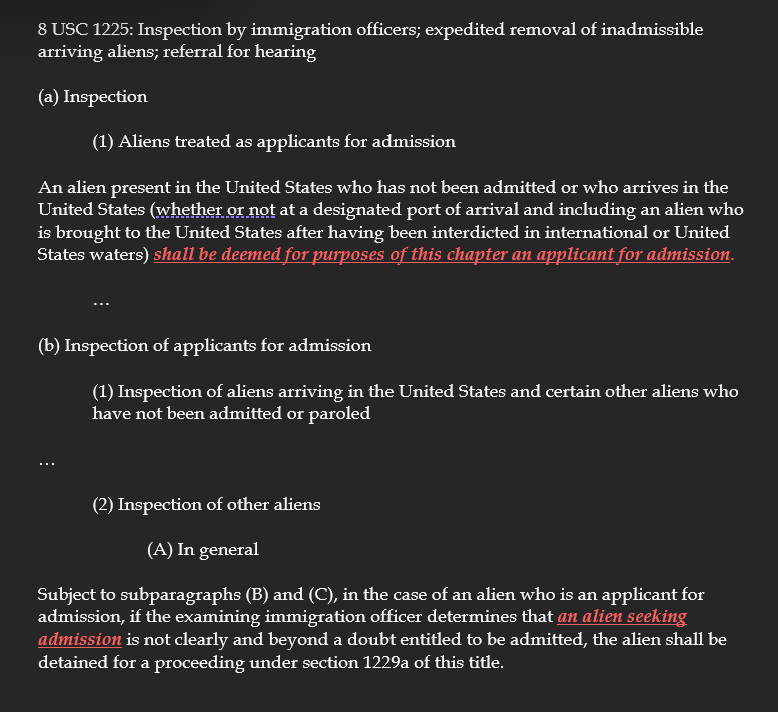
Last Friday, the Fifth Circuit held that many immigrants arrested inside the U.S. after unlawful entry can be treated as “applicants for admission” under the Immigration Code and can be detained without bond while their removal cases proceed.The opinion has dranw considerable attention as the first circuit-level treatment of an issue that affects about two million people nationwide.

As the majority begins, the specific statutory interpretation issue “while novel is not recondite.” It can be summarized as follows – whether the highlighted language establishes two conditions for detention, or only one that appears in two different places:

Buenrostro-Mendez v. Bondi, No. 25-20496 (Feb. 6, 2026).

In Dentons US LLP v. Stairway Legacy Assets, LP, the Fifth Circuit held that the Dentons law firm was not a third-party beneficiary of a contract  (while also concluding the merits of this point had been forfeited.).

Under Delaware law, a third-party beneficiary must show that the contracting parties intended to benefit the third party, that any benefit was a gift or in satisfaction of a preexisting obligation, and that the intent to benefit was a material part of the contract’s purpose, with courts looking to the contract’s language to discern that intent. .

The contract did not identify Dentons or its predecessor, and the claimants did not  “facts which could reasonably lead to the inference” that the parties intended to benefit Dentons, not crediting an argument about the general “Net Revenues” definition in the contract. No. 25-40235; Feb. 2, 2026

McLemore v. Lumen Technologies held that the district court abused its discretion by dismissing a securities complaint with prejudice, without explaining why amendment would be futile, emphasizing that the default practice is dismissal without prejudice or liberal leave to amend. Specifically, the Court noted that Rule 15(a)(2) “evinces a bias in favor of granting leave to amend,” and that an initial Rule 12(b)(6) dismissal should ordinarily be without prejudice unless it is clear the defects are incurable. The Court declined to opine on the merits of the securities claims. No. 25-30264; Jan. 30, 2026.