Salvador Dali mused about the malleable nature of time in his painting The Persistence of Memory.

Similarly, a Biden-era dispute between the Texas and federal governments, addressing an aggressive state statute about immigration enforement, was resolved by a 2-1 panel opinion in favor of federal preemption in United States v.Texas.

Despite the change of Administrations–and with it, a massive budget increase for ICE that drastically expanded federal immigration enforcement–this Biden-era remannt will now be reheard en banc later this year or early next.

The panel majority in Spectrum WT v. Wendler concluded that a student-organized drag show is protected expressive conduct under the First Amendment. The court emphasized that theatrical performance “plainly involve[s] expressive conduct,” and that in the context of an LGBT+ charity event, the show’s message of solidarity was “unmistakable.”

Because the university’s auditorium was opened to a wide range of outside speakers and events, the panel classified it as a designated public forum; banning drag shows was therefore a content-based restriction subject to strict scrutiny. The majority found no compelling justification for that ban, noting that the school already had time-, place-, and manner rules to police lewd conduct and that “a pointed expression of solidarity” could not be suppressed simply because administrators disliked the medium chosen.

The majority summarized: “[T]his drag show would convey such a message. That is enough to implicate the First Amendment.” A dissent would defer to the university administration. No. 23-10994, Aug. 18 2025.

Fire Protection Service, Inc. v. Servitec addressed whether several key terms in the “Texas Fair Practices of Equipment Manufacturers, Distributors, Wholesalers, and Dealers Act ” are ambiguous.

The threshold question was whether the plaintiff engaged in the sale of “equipment” as defined by that statute, which in turn raised the question whether its products–a type of lifeboat–are used by a kind of commercial activity referenced by the statute, and if so, whether their use is “in connection with” that activityu.

As for the type of activity, examining the terms “mining” and “industrial activities,” the Court canvassed dictionaries and long-standing Texas precedent and ruled that each term carries a settled, ordinary meaning broad enough to encompass offshore oil and gas operations, commercial shipping, and similar endeavors.

Turning to the statutory phrase “used … in connection with,” the court again found no textual uncertainty. Citing recent Texas Supreme Court authority, the panel emphasized that the words “in connection with” are inherently expansive and “cannot ‘imply more than a tangential connection’ unless the statute’s text constricts its ordinary meaning.” Because the Act contains no such limiting language, the court held that the statute unambiguously sweeps in equipment—such as life rafts—that bears even a tangential relationship to the covered commercial contexts. Noi. 24-20405 (Aug. 21, 2025).

Anticipatory breach, or the lack of it, was the question in Penthol LLC v. Vertex Energy Operating LLC. Applying Texas law, the panel emphasized that repudiation requires an “absolute and unconditional” refusal to perform, and a trading company’s  letter did not meet that standard–it merely warned that the distributor would terminate the agreement if the manufacturer failed to cure an alleged breach within thirty business days.

Because that warning was both conditional (performance could still be rendered) and prospective (termination would occur only after the cure period), the court concluded it was not a repudiation. As the opinion summarized: “Letter 1 neither constituted nor served as the starting point for a repudiation, because [the] threat of nonperformance was neither absolute nor unconditional.”No. 24-20329, Aug. 14, 2025.

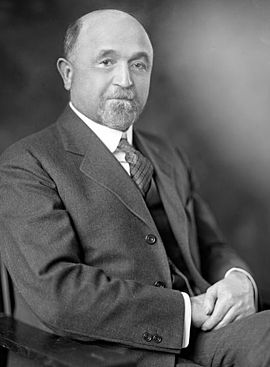
SpaceEx v. NLRB holds that the National Labor Relations Board’s “for-cause” removal protection for its five Members is likely unconstitutional because the Board, unlike the 1935 Federal Trade Commission, “is not a ‘mirror image’ of the FTC.” In the Fifth Circuit’s view, the Board wields extensive executive power—adjudicating unfair-labor-practice charges, directing elections, and petitioning federal courts for injunctions—yet lacks any statutory party-balancing requirement. Those differences place the NLRB outside the narrow safe harbor created by Humphrey’s Executor.

A dissent argued that an injunction should not issue absent proof that the contested provisions actually harmed the employers. No. 24-50627 (Aug. 19, 2025). (Mr. Humphrey appears above; history does not seem to have recorded an image of his executor.)

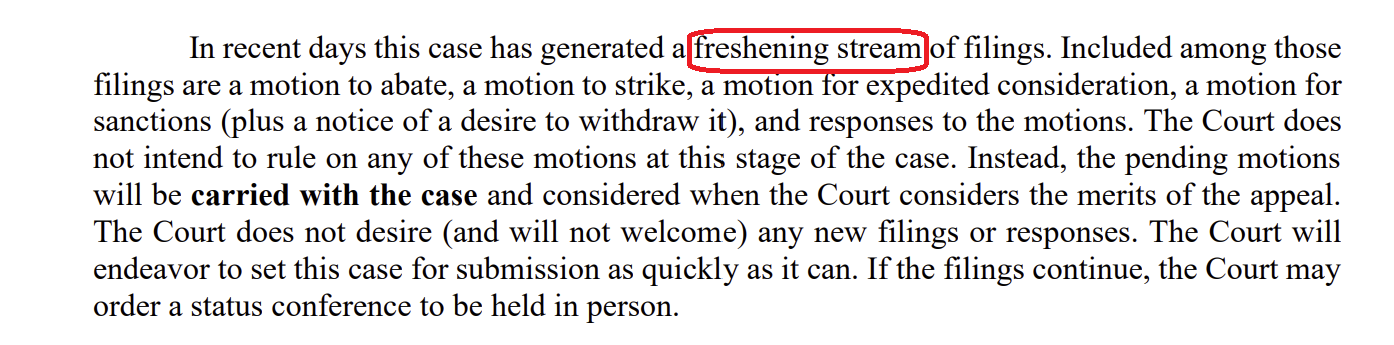
Hon David Gunn of Houston’s First Court of Appeals has given new life to the word “freshening” as an adjective for a frustrating series of court filings (thanks to Ben Taylor for drawing my attention to it):

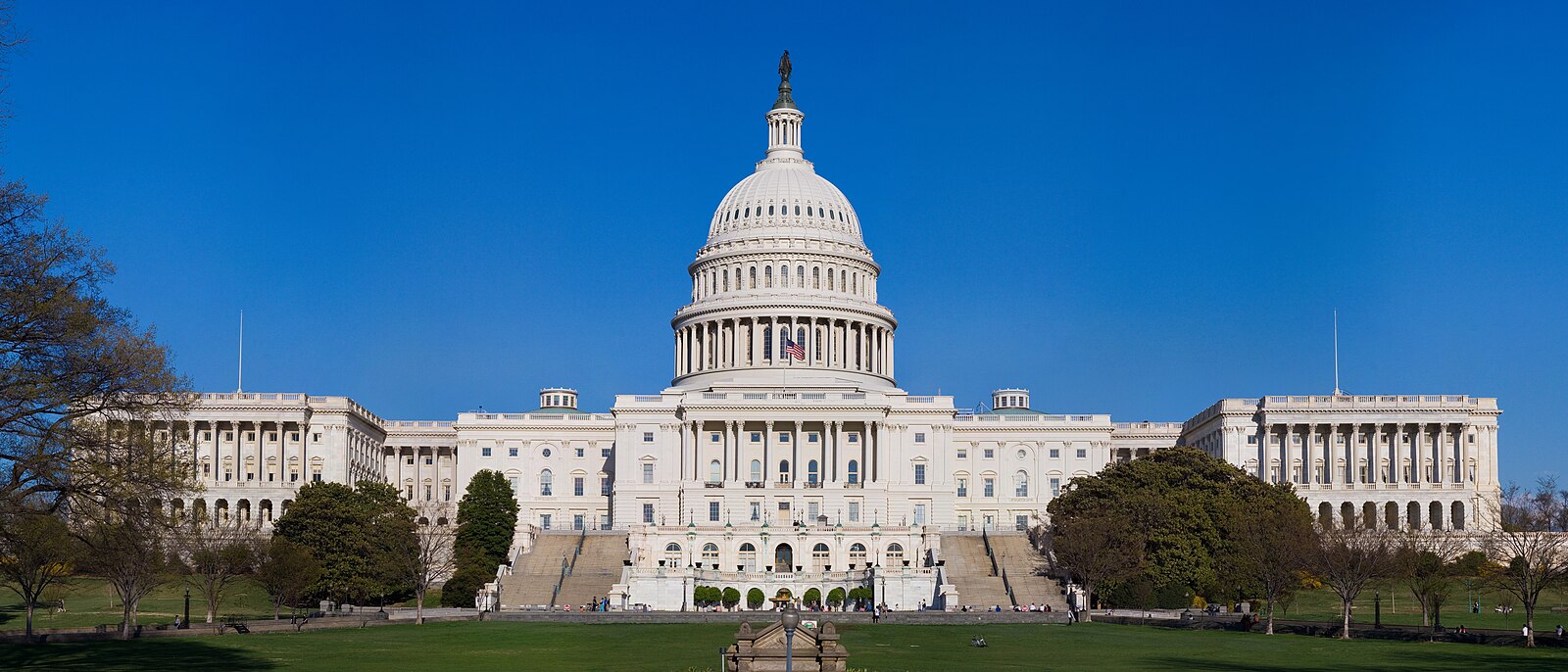
Quorum issues have vexed efforts to have a special Texas legislative session in 2025. Meanwhile, in State v. Bondi, a Fifth Circuit panel majority held that the House may constitutionally count Members who vote by proxy toward a quorum. It reasoned that the U.S. Constitution’s Quorum Clause “does not require physical presence,” emphasizing that the Constitution speaks only of a “majority” and leaves each chamber broad discretion to decide how to “ascertain the fact” of that majority.

Specially, the Court concluded that remote‐participation rules adopted during the pandemic merely supply a permissible method for determining whether enough Members are participating, not a redefinition of the quorum itself. Because the underlying legislative record indisputably showed that more than half the House either voted or authorized a proxy to do so, the court declared that “the Constitution’s text, history, and tradition support remote voting and counting proxies as sufficient for quorum.”

The panel warned that reading the Constitution to demand physical presence would empower a minority to block legislation and “undermine the very purpose of the Quorum Clause: to ensure majoritarian rule.”

A dissent argued that the Quorum Clause’s reference to “compel[ling] the Attendance of absent Members” and more than two centuries of congressional practice show that a quorum exists only when a majority are physically in the chamber. By allowing the House to satisfy the quorum requirement with paper proxies, the dissent argued, the court stripped the Clause of its structural safeguard against minority rule and permitted Congress to “define the Constitution’s quorum requirement out of existence.” No. 24-10386, Aug. 15, 2025,

In DM Arbor Court, Ltd.. v. City of Houston, the Fifth Circuit held that the City’s denial of repair permits under its flood control ordinance constituted a categorical taking under the Supreme Court’s Lucas framework.

After the Arbor Court apartment complex was severely damaged by flooding, the City refused to issue repair permits unless the buildings were elevated to meet new floodplain requirements—a cost the court found to be “prohibitively expensive” and “economically unfeasible.” Both the property owner’s and the City’s experts agreed that, under these conditions, there was “no economically viable, or feasible, or beneficial use of the property.” The Fifth Circuit stated, “Saying that a property’s only remaining use is to hope for future development is the same as saying that the property must remain idle today. That is a categorical taking under Lucas.”

A dissent argued that the district court’s analysis was correct, emphasizing that Lucas takings are reserved for the “extraordinary case” where a regulation “permanently deprives property of all value. No. 23-20385, Aug. 12, 2025

Palms v. Texas Childrens Hospital, a case about religious objections to a flu vaccine, produced a difference of opinion as to whether the plaintiff’s accommodation claim had been forfeited.

The majority held that the plaintiff had forfeited her argument by failing to adequately brief how the district court erred in granting summary judgment, emphasizing that she “never states that TCH’s offered accommodation was unreasonable or explains why the district court could not dismiss her claim on this ground.” Citing established precedent, the majority reasoned that a party forfeits an argument by failing to “offer any supporting argument or citation to authority” or to “identify relevant legal standards and any relevant Fifth Circuit cases.”

The dissent contended that the plaintiff’s opening brief sufficiently challenged the timing and adequacy of the hospital’s accommodation, expressly arguing that the hospital’s delay in granting an accommodation was unreasonable and resulted in her being “impermissibly ‘suspended without pay’ due to her religious beliefs.” The dissent criticized the majority’s approach as a “legal trick-box” that would deprive employees of the ability to pursue meritorious claims of religious discrimination simply because the employer eventually ceased the challenged conduct. No. 24-20174, Aug. 11, 2025

A civilian treatement of contract formation appears in CAM Logistics LLC v. Pratt Indus., Inc., which applied Louisiana law to the question whether parties can be bound to a contract when they have not executed a written agreement, despite ongoing negotiations and partial performance.
The court held that when both parties contemplate a written contract as the form of their agreement, there is a presumption under Louisiana law that they do not intend to be bound until the contract is executed in that form. The presumption applied here because both sides “bargained for a written contract” and took steps such as exchanging draft agreements and seeking legal review, but never finalized or signed any document. ”

The court further rejected the argument that the parties’ performance—such as providing services and making payments—could override the lack of a signed contract (or in civilian parlance, “evidence the intention to cure its relative nullity”). No. 24-30806, Aug. 6, 2025.

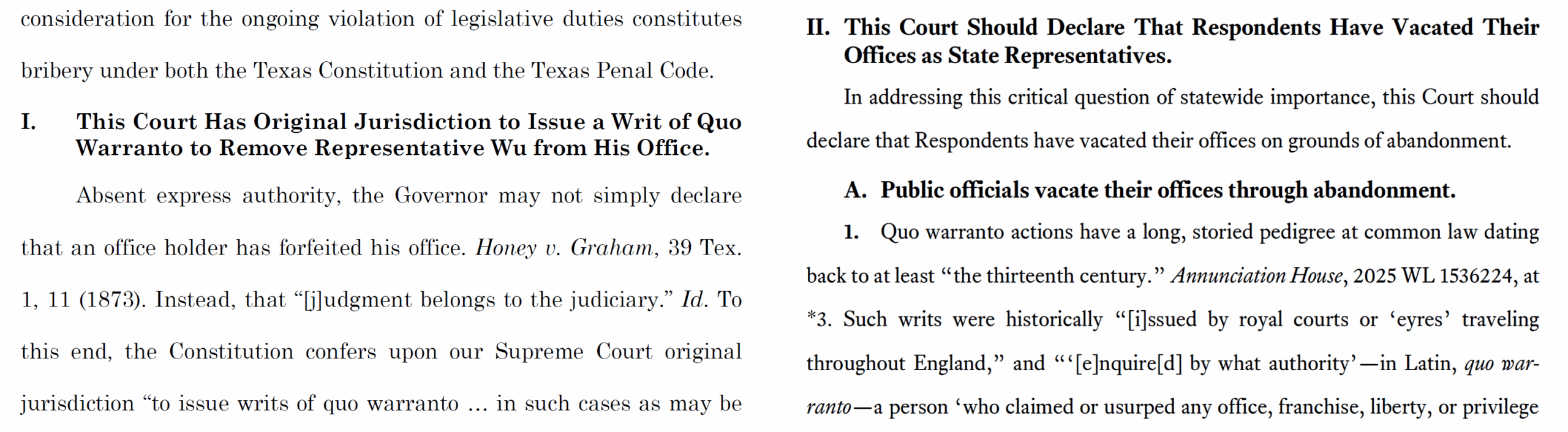
The flight of the Democratic delegation from the Texas House has drawn a great deal of attention. The resulting legal filings in the Texas Supreme Court (Ken Paxton’s here, and these are the petition, response, and reply from the action filed by the Governor) display quality legal writing and excellent font choice. The Governor has chosen a classic look with a Century font, while the Texas Solicitor General uses Equity–generally speaking, a superior font, but perhaps not with the identical margins and spacing that one would use with Century:

Barnett v. American Express rejected a claim that arbitration was waived by substantially invoking the judicial process: “American Express did not substantially invoke the judicial process on Barnett’s FCRA claim by suing to collect her debt. Its previous suit brought only a generic breach of contract claim under Mississippi law. That is undoubtedly a different claim than Barnett’s subsequent FCRA action, which American Express immediately sought to arbitrate.” No. 24-60391 (July 29, 2025).

In Angelina Emergency Medicine Associates v. Blue Cross, the Fifth Circuit addressed the ambiguity of language used in various assignments of benefits, including terms such as “health care providers” or “practitioners providing care and treatment.”

The Court found that these terms were ambiguous as to whether they encompassed physician groups as assignees, noting that the assignments used “plain English for a lay audience” and that the descriptive, role-based language could reasonably be interpreted to include a class of people such as the physicians providing care to the patients. The court observed that there was no clear legal or contractual definition of “provider” in this context, and that the term could refer to both individual doctors and groups of doctors.

The Court further emphasized that the absence of “more precise form-language that explicitly delegates rights to the management entities to which the facility-based physicians belong” does not invalidate the assignment, given the ambiguity present. As a result, the court vacated summary judgment on this issue, holding that the ambiguity in the assignment language created a fact issue that precluded summary judgment. No. 24-10306, Aug. 8, 2025.

In Wright v. Honeywell Int’l, a Title VII case about a COVID vaccination requirement, the Fifth Circuit held (citations omitted):

Viewing the evidence in the light most favorable to Wright and drawing all reasonable inferences in his favor, a reasonable jury could find that Wright held at least a mixed motive for his vaccine refusal: a bona fide religious belief alongside political beliefs and personal preference. Wright’s evidence demonstrates a “moral or ethical” belief in bodily autonomy and freedom to choose what to put in his body.  The fact that he gave additional reasons for his vaccine refusal does not show that his belief is “merely a preferred practice.”  Instead, it simply shows that his vaccine refusal is grounded on both religious and nonreligious reasons. Furthermore, the inquiry on this prong is not “whether [Wright’s specific] belief is a true religious tenet” of the Baptist faith, but rather whether the belief is, “in his own scheme of things, religious.” Because a plaintiff’s sincerity in espousing a religious practice “is largely a matter of individual credibility,”  Wright’s evidence would be better weighed by a jury than by the court at the summary judgment stage.

A footnote considers whether future Supreme Court opinions may exclude “purely moral or ethical beliefs” from the protection of Title VII; cf. U.S. Const. amend. I (creating some tension when guarding against both “respecting an establishment of religion” and “prohibiting the free exercise thereof”).

In the department of “things I did not know before,” I learned about the “federal enclave” doctring from Vinales v. AETC II Privatized Housing, LLC. This “enclave” arose when Texas ceded land to the federal governement for an air base, which had these consequences:

Generally, when an area in a State becomes a federal enclave, ‘only the [state] law in effect at the time of the transfer of jurisdiction continues in force’ as surrogate federal law.” “Existing state law typically does not continue in force, however, to the extent it conflicts with ‘federal policy.’” “And going forward, state law presumptively does not apply to the enclave.”

No. 24-50113 (June 27, 2025) (citations omitted).

Judge Roy Bean famously considered himself to be “The Law West of the Pecos” (right). Judge Bean would have been at home in Jones v. King, a dispute about whether certain would-be voters actually resided in remote Loving County – the least populated county in the US.

The Fifth Circuit held that presiding over the general assembly of prospective jurors—including qualifying jurors and hearing excuses or exemptions—is a judicial act protected by absolute immunity. (The plaintiffs contended that they had been unfairly treated after appearing for examination as potential jurors.) The Court emphasized that the “touchstone” of the analysis is whether the judge is “resolving disputes between parties” or “authoritatively adjudicating private rights,” and that the act of qualifying a venire and hearing excuses inherently involves the exercise of judicial discretion.A dissent saw the judge’s activity as administrative in nature. No. 23-50850, Aug. 1, 2025